Posts

Five Tips for Your Vocal Routine

Image
by A.C.T. Staff An actor’s voice is one of the most important tools in their toolbox. Below, voice teacher and instructor in A.C.T.’s San Francisco Semester Jessica Berman shares five tips for taking care of your vocal instrument.  Jessica Berman 1. Focus on posture and alignment, especially when speaking online. Hopefully the days of spending hours on Zoom will soon be behind us, but in the meantime, if you find that your voice feels fatigued after long stretches of vocal use online, take a moment every 30–60 minutes to do a little physical reset. You can: Drop down your spine so that your whole upper body is hanging from your tailbone (you can do this seated or in standing) Shake out your shoulders Gently roll your head and neck around Give your arms and legs a little pat and notice the sensations that you feel in your body As Kristin Linklater says in her book Freeing the Natural Voice , “The efficiency of the vocal apparatus depends on the alignment and posture of the body and ...

Seven Signs That Dolly Levi and the Ghost of Christmas Present Are the Same Person

Image
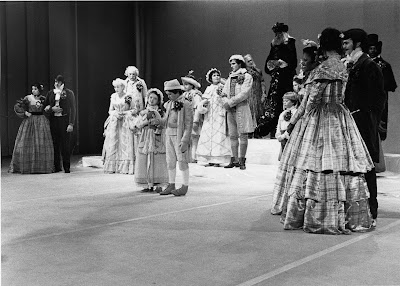
  by A.C.T. Staff 1. They both know how to work a head-to-toe look. A.C.T.'s  A Christmas Carol Its dark brown curls were long and free; free as its genial face, its sparkling eye, its open hand, its cheery voice, its unconstrained demeanor, and its joyful air . . . “You have never seen the like of me before!” exclaimed the Spirit. —Charles Dickens,  A Christmas Carol A.C.T.'s  The Matchmaker   MRS. LEVI: I’ve seen the workroom a hundred times. I’ll stay right here and try on some of these hats. —Thornton Wilder, The Matchmaker   2. They both believe that a well-laid table can work magic. A scene from A.C.T.'s A Christmas Carol   MRS. LEVI: I’m the best cook in the world myself, and I know what’s good. —Thornton Wilder, The Matchmaker   3. Pretty much everything would be better if we all followed their advice. This boy is Ignorance. This girl is Want. Beware them both, and all of their degree, but most of all beware this boy, for...

From Stage to Screen—Tips to Remember for On-Camera Acting

Image
by A.C.T. Conservatory Staff At the A.C.T. Conservatory, we seek to develop the artist in every actor and prepare them to succeed in all aspects of the profession, including acting in film and on television. Whether on stage or screen, acting is about conveying the emotional truth of the character, but the change in medium requires some adjustments. Below, actor Warren David Keith—who also directs and teaches at A.C.T.’s Summer Training Congress—shares some tips for stage actors looking to translate their skills on camera. Warren David Keith 1) The distance of communication has changed. The back row of the theater may be 20 feet or hundreds of feet. It might be the Aurora or the second balcony of the Geary Theater, but that is the distance that the theater actor must bridge. On film it is only the distance to the lens and to the microphone. 2) Performance and experience. In the theater you must render a performance in order to be seen and heard in the furthest seat. The camera detects ...

Five Ways to Get the Most Out of Your Actor Training

Image
By Peter J. Kuo A.C.T.’s Director of the Conservatory, Peter J. Kuo, offers these five tips to actors who are thinking about engaging in any form of rigorous or intensive training. Whether it’s for two weeks or five years, these tips may help you get the best out of your actor training. Peter J. Kuo 1. Take Advantage of Access to Opportunity When you join an extensive training program, you gain access. Reach out to staff members you’re interested in chatting with, see if you can sit in on other classes, try to grab coffee/tea with an artist or faculty member that you’re not working with but want to get to know. See if there are jobs or volunteer opportunities, or investigate the library and archives. The worst anyone can say is “no.” And a “yes” can open up access to so much opportunity! 2. Learn How to Take and Decipher Feedback Not all teachers are the best communicators, but they have knowledge, information, and insight you’re seeking. Learn to take the feedback you are given, proce...

To Inspire, Lift, and Liberate—the Enduring Vision of Alice Childress

Image
By Arminda Thomas   Announcing her death in 1994, the New York Times headline read, “Alice Childress, 77, a Novelist,” though the full obituary allowed that she also wrote some plays. While Childress would likely have objected to that order, having devoted the bulk of her life to playwriting, the paper of record’s choice is understandable. As a playwright, Childress’s story is more difficult to measure: hers was a progressive voice too often hemmed in by anxious, benighted producers; a mainstage talent shoehorned into black box realities. Alice Childress. Photo courtesy of Arminda Thomas. The story began, promisingly enough, at a little Harlem theater with a big mission, the American Negro Theatre—a company so hardworking members called themselves the ANTs, and were expected to function as actors, directors, designers, and box office managers. "The American Negro Theatre Company," Childress recalled, "worked ten years without salary, four nights per week, keeping the sa...

For the Heart of Frisco—Downtown High School Exhibition Goes Viral

Image
By Livian Yeh   On December 10 and 11, 2020, students from San Francisco’s Downtown High School performed an hour-long exhibition of original works, created with their teachers Charmaine Shuford and Robert Coverdell, A.C.T. teaching artist Carlos Aguirre, with classroom support from Sabrina Belara and Bianca Fernandez, and in collaboration with the writing staff and tutors from 826 Valencia.  The performance, titled For the Heart of Frisco , was the final presentation of the Acting for Critical Transformations Project at Downtown High School. Students wrote, directed, and acted in monologues and short plays about gentrification and activism in the city. In Eulogy to San Francisco , the class held a candlelight vigil for their city, which has long ceased to be affordable and equitable. This Trend Cannot Continue focused on painful truths about the cost of living here: the rent has gone up $2,400 in 24 years, and landlords raise the rent by 2.6% every year. In Kimberly’s Play ,...

Evocation, Inspiration, and Ignition—A.C.T.’s Blood Wedding Brings the Spirit of Duende to Life

Image
by A.C.T. Publications Staff The spirit of duende , the Spanish term for passion and inspiration, is central to the works of Federico García Lorca. For A.C.T.'s production of Lorca's  Blood Wedding , director Christine Adaire and actor Hernán Angulo share their interpretation of duende , and how it influenced their production. Federico García Lorca (courtesy of Wikipedia) Federico García Lorca was obsessed by the spirit of Duende . Duende is one of the most elusive words in the Spanish language. Literally, it means “ghost” or “goblin.” In art, particularly drama, dance, and the music of Flamenco, it refers to the powerful energy emitted by a performer to captivate the audience. Lorca gave a lecture in Buenos Aires in 1933 in which he described duende as “a force, not a labor, a struggle, not a thought,” “the mystery, the roots that cling to the mire we all know,” and “a creature who sweep[s] the earth with its wings of rusty knives.” It is not based in reason or the...

The Evolution of a Holiday Classic: A Christmas Carol at A.C.T. Part Two

Image
By Michael Paller * This article originally appeared on Inside A.C.T. in 2016.  By 2004,  A Christmas Carol  was 28 years old, and the sets were showing their age. A significant investment would be required to refurbish them, which set Artistic Director Carey Perloff to thinking.  Carol  had more than served its purpose since 1976. Every year but 1994 and 1995, when the production was put on hiatus until The Geary reopened, many young Bay Area children—and parents—had their first theater experience watching Bill Paterson, Sydney Walker, Raye Birk, or Ken Ruta awake on Christmas morning a changed man. Now, however, Perloff wanted  Carol  to serve an additional purpose, featuring parts for students in the Young Conservatory, and roles for actors in M.F.A. Program who could add the mainstage experience toward earning their Actors’ Equity union card. A.C.T.'s 2009 production of  A Christmas Carol . From the left:  Ren é Augesen, Gregory Wallace, ...

The Evolution of a Holiday Classic: A Christmas Carol at A.C.T. Part One

Image
  By Michael Paller  * This article originally appeared on Inside A.C.T. in 2016.  In the mid-1970s, regional theaters around the country discovered that audiences wanted a Christmas story at Christmastime, and none more so than Dickens’s  A Christmas Carol . Adaptations began appearing, starting with the Guthrie (1974) and the Actors Theater of Louisville (1976). Artistic Director Bill Ball asked Company Director Laird Williamson to look at the handful of existing adaptations and choose one to direct. Williamson found them sentimental and clichéd. They were “sugar-coated Dickens,” he said. “Tiny Tim is not the leading character. Scrooge is the real story.”  The cast of A.C.T.'s 1981 production of  A Christmas Carol . Williamson was drawn to the tale’s psychological and social realism, to its “comment on poverty and the inequality of the classes.” He suggested that he and Dennis Powers, the company’s literary jack-of-all-trades, do their own version. Ball a...

The Prepared Mind: An Interview with Emma Van Lare

Image
By Claire L. Wong and Alejandra Maria Rivas Emma Van Lare grew up in Spring, Texas, 22 miles from Houston. Her parents immigrated from the Republic of Ghana in West Africa. “I’m first-generation Ghanaian American,” Van Lare says, “so I think I’m of two places, actually.” When planning out her career, Van Lare sat her parents down and told them, “Look. I am not going to business school. I want to be an actor.” Her mom said, “Okay, but you have to treat it like a business. It can’t be a hobby.” Emma Van Lare. Photo by Deborah Lopez.  “I appreciated that,” Van Lare says, “because my mom’s a doctor, my dad’s an insurance business guy. Their background was, [ dramatic voice ] ‘Education is the way! The truth and the light!’ I appreciated them telling me that, because it showed that they were not rigid, they were very supportive. In creative work, you have to be your own engine and treat it like a business even if you’re not making money from it. It’s the only way you’ll survi...

Uncovering a New Dimension: Director Peter J. Kuo on the Making of In Love and Warcraft (Part Two)

Image
By Allie Moss Click here to read Part One of this profile.  Originally, In Love and Warcraft was conceived as an in-person production to take place with A.C.T.’s MFA students in May 2020. But in the midst of the pandemic, A.C.T.’s Conservatory was forced to “pivot” and mount the show online instead. The May production did much more than fulfill the curricular need for student performance; it inspired a remount co-production from A.C.T. and Perseverance Theater, and it birthed a new medium that Kuo calls “live video theater.”  “Live video theater” is exactly what it sounds like: theater, happening on video, streaming live. And that live element is key; it’s what makes this form distinct from recorded videos of past theater productions. “When you’re watching something live versus recorded, the brain activates in a way that goes, ‘okay, something can happen,’” Kuo says. “That’s what I think liveness does; it allows us to be more forgiving, and lean into theatrical conventi...

Uncovering a New Dimension: Director Peter J. Kuo on the Making of In Love and Warcraft (Part One)

Image
By Allie Moss Madhuri Shekar’s In Love and Warcraft is a play for our times. While there’s no mention of a pandemic, it expertly draws out questions of intimacy and relationship-building in virtual space. The play centers on Evie, a college senior who is navigating a budding in-person romance alongside an online relationship with her long-distance gamer boyfriend, with whom she plays World of Warcraft. By rehearsing and presenting the production on Zoom, life mirrors art as six of A.C.T.’s MFA actors are tasked with reaching through the screen to create deep connections. Peter J. Kuo, the production’s director, is profoundly aware of this overlap. “It’s not just that [the show] translates well into the online medium,” he says. “It actually shows that internet relationships have meaning and are palpable.”  Peter J. Kuo. Photo Courtesy of Peter J. Kuo. This play resonates for Kuo in part because he has personal experience building relationships over the internet. “My main introducti...

Envisioning the Future: An Interview with Peter J. Kuo

Image
  By A.C.T. Publications Team  Peter J. Kuo is a director, producer, writer, and educator focused on raising the visibility of marginalized communities. As social justice programs coordinator at The New School, he founded the NSD: Affinity Groups program and was involved with several EDI initiatives. He is the co-founder of Artists at Play, a Los Angeles Asian American Theatre Collective. As a director, he has worked at the Williamstown Theatre Festival, the Oregon Shakespeare Festival, East West Players, South Coast Rep., Geffen Playhouse, Rattlestick Playwrights Theater, Leviathan Lab, Ma-Yi Theater Company, Pan Asian Repertory Theatre, and others. He was recently named one of Theatre Communications Group's Rising Leaders of Color. A.C.T. Associate Conservatory Director Peter J. Kuo. We are so excited to have you at A.C.T., Peter! What drew you to this role?  I had just received my MFA in directing from The New School when I heard from A.C.T.’ s new artistic director, P...

Learning to Trust Yourself: An Interview with Kimberly Hollkamp-Dinon

Image
By Livian Yeh Hailing from Jeffersonville, Indiana, Kimberly Hollkamp-Dinon attended A.C.T.’s Summer Training Congress after graduating from college. “I immediately fell in love with the learning and training environment, and with the community here at A.C.T.,” she says. “I knew it was a place in which I could thrive.” Three years later, Hollkamp-Dinon has grown in technique, confidence, and artistry. We caught up with her to chat about her time in the MFA program, embracing her weirdness, and her love of The Great British Bakeoff . Kimberly Hollkamp-Dinon. Photo by Deborah Lopez.  What's your favorite part of the MFA Program? Definitely my classmates. I have learned so much from my fellow ensemble members of the class of 2020. I’m so grateful to work with them and learn from them. I have found lifelong collaborators in this group of artists. One of my favorite projects was when we all worked on a production of The School for Scandal directed by [MFA Program Head of V...

The Negro Leagues: Toni Stone in Historical Context

Image
  By A.C.T. Publications Staff Have you ever heard of the New York Black Yankees? What about the Homestead Grays, Baltimore Black Barons, or Cincinnati Tigers? From the 1880s until the 1950s, there were two professional baseball systems in the United States: one for white players, and another for Black Americans. Both contributed to the development of the modern game and baseball industry. This year, 2020, marks the centennial of the Negro Leagues, which was founded by Andrew “Rube” Foster,  retired pitcher and owner of the Chicago American Giants, in February 1920 to “create a profession that would equal the earning capacity of any other profession . . . keep Colored baseball from the control of whites . . . [and] do something concrete for the loyalty of the Race.” The 1943 Homestead Grays lineup included several future Hall of Fame players: Cool Papa Bell (back second from left), Josh Gibson (back fifth from left), and Buck Leonard (back second from right). Photo courte...

Seeking the Magic: An Interview with Lily Harris

Image
By Livian Yeh After graduating from Reed College with a degree in English, Lily Harris entertained career paths in teaching, academia, and horseback riding, but ultimately landed on acting. Learning about A.C.T.’s MFA program from a friend and eager to improve her craft, the Los Angeles native auditioned and was accepted as part of our class of 2020. She talks to us about her time in the program, her inspiration, and finding joy in life as an artist. Lily Harris Headshot. Photo by Deborah Lopez.  How have you grown in your artistry in the past three years being in the MFA Program? I am so much more confident in sharing myself with others. I think I started acting because I felt it gave me permission to show parts of myself I didn’t feel comfortable sharing in everyday life. Although that is definitely still true, one of the most important lessons I’ve learned is that the only person who can give you permission to do or be something is you . I am much more conscious ...