Posts

Showing posts with the label ACTRhino

Behind the Scenes at A.C.T.: An Interview with Head Stage Manager Elisa Guthertz

Image
By Annie Sears Elisa Guthertz has been stage managing at A.C.T. for 26 years, but as a third-generation San Franciscan, her connections to The Geary started long before that. Her father grew up seeing shows on that stage, and he encouraged his daughter’s love of theater as she grew up. After earning her BFA in stage management at North Carolina School for the Arts, she returned home to San Francisco in 1992 to intern at A.C.T. during Artistic Director Emerita Carey Perloff’s first season. In 2005, she took over as head stage manager. Guthertz has done shows all over the world—from Russia to Broadway, from Washington, DC, to Calgary, Canada. Most recently, she stage managed Rhinoceros at The Geary. We recently sat down with Guthertz to get a backstage glimpse into pulling off a production. A.C.T.'s Head Stage Manager Elisa Guthertz. Photo by Annie Sears. How did you first get into stage management? When I was about 13, my brother was involved with a community theater. He ...

Rhinos 101

Image
By Annie Sears As the title would suggest, Eugène Ionesco’s Rhinoceros —playing through June 23 at The Geary—features some lumbering pachyderms. The play isn’t really about rhinos, but they’re a constant onstage presence. Characters are always talking about rhinos, gawking at rhinos, or in some cases, transforming into rhinos. Our marketing department visited the San Francisco Zoo & Gardens to learn some fast facts about these mysterious creatures. 1. A group of rhinos is called a crash . Does that make the Rhinoceros cast a crash? A crashing cast? A casting crash? 2. Their horns are made of keratin —the same protein that makes up human fingernails! Boone, the black rhinoceros at the San Francisco Zoo, shows off his two horns. Photo by Elspeth Sweatman. 3. Some rhinos have one horn. Others have two . Gene and Berenger have a disagreement about this in Rhinoceros , so let’s break it down: There are five different species of rhinos. Two of those species, the black rhino...

Catching Rhinoceritis

Image
By Annie Sears Eugène Ionesco’s Rhinoceros , playing at The Geary through June 23, presents a series of challenges to theater-makers. How do you fill a stage with stampeding rhinos, wreaking havoc on a French provincial town? And how does one portray a rhino convincingly? Actor Matt DeCaro has figured out how to take the audience on “an imaginary ride,” says DeCaro. “I want it to be fun to watch.” Actor David Breithbarth and Matt DeCaro in Asolo Repertory Theatre's 2018 production of Rhinoceros . Photo by Cliff Roles. For many actors, the first consideration when stepping into a physical role is where the character’s energy emanates from and which part of the body initiates motion. To discover a rhino’s primary impetus, DeCaro took a trip to the zoo. “I looked at rhinoceroses for a while to try and see how they move,” says DeCaro. “Well, they didn’t move much, but I noticed a lot of it is from the shoulders.” So DeCaro leads with his shoulders, sometimes moving unilaterall...

Join the Crash, Embrace the Herd

Image
By Elspeth Sweatman A crowd. Photo courtesy Pxhere.   Like it or not, humans are herd animals. From the moment we are born, we crave interaction, communication, affection. To achieve these needs, we accept rules and traditions that help us to fit in, get along, and stay safe. Yet, we also know how dangerous going along with the group can be. Our news reels and Netflix queues are full of examples of innocent bystanders being duped, injured, or killed because they followed others. How can herd mentality be both the bedrock of our civilization and its undoing? There are two types of herding: self-interested (when we copy the motivations and actions of others for our own gain) and collective (when we imitate others for the advantage of the entire group). When we go to a Giants baseball game at Oracle Park and follow the crowd to the entrance, that’s self-interested herding; we assume people know where they are going. When we stand on the right-hand side of escalators to let ot...

Rhinos Roaming Through Our Psychological Savannas

Image
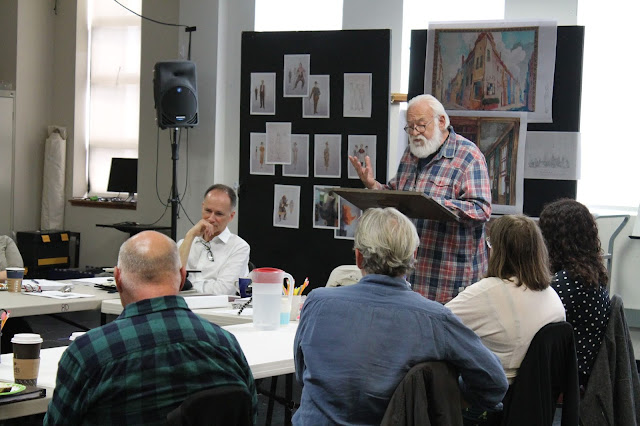
By Annie Sears At the first rehearsal for Rhinoceros , director Frank Galati reminded the cast, crew, and A.C.T. staff that during the 1930s and ’40s, playwright Eugène Ionesco watched his friends succumb to popular political beliefs. In his memoir, Ionesco recalls chatting with his friends—university professors, students, journalists, critics, and other intellectuals—to dismantle fascist propaganda. All but three of those friends eventually changed their allegiance, even those who had claimed to be fascism's firmest opponents. To Ionesco, these friends were “pseudo-intellectuals” because they didn’t truly think; instead, they regurgitated predominant systems of thought. “They were caught in the mechanism,” wrote Ionesco. “They accepted everything. They became rhinoceroses.” Director Frank Galati addresses the cast and crew of Rhinoceros at the first rehearsal. Photo by Elspeth Sweatman. Absurdist theater artists such as Ionesco believed that fascist ideologies were...