Posts

Showing posts with the label Heisenberg

The Fusion of Physics and Theater in Simon Stephens's Heisenberg

Image
By Elspeth Sweatman At first glance, science and theater may seem like chalk and cheese. These two fields, however, have been intimately connected for centuries. As Renaissance scientists such as Galileo, Copernicus, and da Vinci were discovering new aspects of our world, sixteenth- and seventeenth-century playwrights were referencing these discoveries in their works. Sarah Grace Wilson as Georgie Burns and James Carpenter as Alex Priest in A.C.T.'s 2018 production of Heisenberg . Photo by Kevin Berne. The protagonist of Christopher Marlowe’s Doctor Faustus embraces the Renaissance spirit of scientific exploration to his own detriment, and Subtle, one of the three conmen in Ben Jonson’s The Alchemist , relies on the cutting-edge (and spurious) science of alchemy—transforming base metals into gold—to trick the wealthy Sir Epicure Mammon. Since these early depictions of science and scientists onstage, playwrights have used the latest scientific innovations as metaphors, a ...

In Search of Alex and Georgie: A Psychologist Explores Heisenberg’s Two Characters

Image
By Taylor Steinbeck “The meeting of two personalities,” wrote Swiss psychiatrist Carl Jung in  Modern Man in Search of a Soul , “is like the contact of two chemical substances: if there is any reaction, both are transformed.” This is what happens when the seemingly incompatible characters of Georgie Burns and Alex Priest collide in Simon Stephens’s  Heisenberg . To find out what makes these characters tick, we reached out to Dr. Mason Turner, the director of outpatient mental health and addiction medicine at The Permanente Medical Group in Oakland, and the host of A.C.T.’s Theater on the Couch—an interactive discussion that follows one Friday-night performance of each mainstage production. After reading the play, Dr. Turner offered some psychological insights into the behaviors of Georgie, Alex, and human beings in general. James Carpenter as Alex Priest and Sarah Grace Wilson as Georgie Burns in A.C.T.'s 2018 production of Heisenberg . Photo by Kevin Berne. Simon St...

A Universe Between Two People: An Interview with Heisenberg Director Hal Brooks

Image
By Elspeth Sweatman It was while he was studying acting in A.C.T.’s Advanced Training Program (the precursor to the M.F.A. Program) in the early 1990s that Hal Brooks discovered he wanted to be a director. After getting his feet wet creating and directing in the Conservatory’s student cabaret, Brooks returned to New York, where he directed Don DeLillo’s Valparaiso and Will Eno’s  Thom Pain (based on nothing) , among other plays. Soon, he found himself not only directing off Broadway at The Public Theater, Second Stage Theater, and Manhattan Theatre Club, but also at regional theaters across the US. Now, Brooks is back where it all started, directing Simon Stephens’s  Heisenberg  for the Geary stage. We sat down with him to discover his love of Stephens’s work and two-person plays. Director Hal Brooks at the first rehearsal of A.C.T.'s 2018 production of Heisenberg . Photo by Taylor Steinbeck. What drew you to Heisenberg ? I’ve always been interested in the relatio...

Why Simon Stephens Titled His Play Heisenberg

Image
By Elspeth Sweatman In February 1927, German physicist Werner Heisenberg felt he was on the verge of discovering something revolutionary. He didn’t have the math yet to back it up, but deep down, he knew he was right. Heisenberg could see a new theory emerging, one that would shake the foundations of Western physics. Physicist Werner Heisenberg. Photo courtesy Wikimedia Commons. In simple terms, Heisenberg’s theory—the uncertainty principle—states that if you know the momentum of an object (such as an electron circling a nucleus), you will not be able to accurately measure its location. The same is true in reverse: you can know the position of the electron, but not its momentum. This is because an electron acts as both a particle (a defined entity) and a wave (something that is harder to pin down accurately because, like the ripples in a pond, it has no set position), and because the very act of measuring the momentum and position affects the results. Heisenberg’s discovery w...

Creativity and Chaos: An Interview with Heisenberg Playwright Simon Stephens

Image
By Simon Hodgson Simon Stephens grew up in Stockport, a provincial British town that the playwright once described as a place “on the edge of things.” Today, however, Stephens is a name known worldwide. His 30-plus plays—including  On the Shore of the Wide World  (2006 Olivier Award) and  The Curious Incident of the Dog in the Night-Time  (2015 Tony Award for Best Play)—have been staged all over the English-speaking world. But while the playwright continues to travel widely for productions of his works, his imagination is still sparked by the red-brick streets where he grew up. In between Stephens’s trips to New York and Melbourne, we talked with him about inspiration, science, and the human condition. Playwright Simon Stephens and his two cats at his London home. Photo by Simon Annand. Courtesy of Simon Stephens. Where did the idea for Heisenberg come from? How did you come up with these two characters? I read a story about a woman in my hometown who came...

Two Molecules in Space: Heisenberg Arrives at A.C.T.

Image
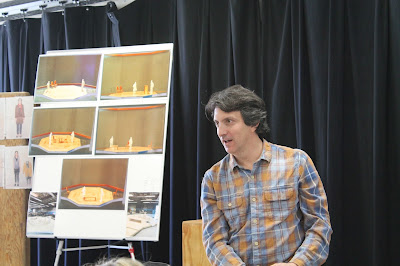
By Taylor Steinbeck Heisenberg  director Hal Brooks has received many questions about the title of his play beginning performances next week at The Geary Theater. “People ask me, ‘Oh, is it about that zeppelin disaster? Is it about Breaking Bad ? No, it’s not,” says Brooks with a laugh. “Others ask, ‘Is it about Heisenberg, the scientist?’ To that I say, ‘It’s not about Heisenberg. It’s about a relationship—it’s looking at his ideas through a relationship.’” The cast and creative team of A.C.T.'s production of Heisenberg at the first rehearsal. Photo by Taylor Steinbeck. At the first rehearsal for Heisenberg , Brooks, an alumnus of A.C.T.’s Advanced Training Program, addressed a room full of faces both familiar and new, and admitted, “I am not a physicist.” With this disclaimer, he briefly explained the science behind Heisenberg . Heisenberg’s uncertainty principle asserts that you cannot measure both the velocity and location of a particle—you can on...