Posts

Showing posts with the label ACTHamlet

Double Identity: Hamlet's Avenging Sons
Image
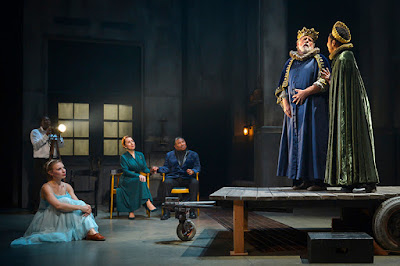
By Elspeth Sweatman In Hamlet , Shakespeare uses doubling—the mirroring of characters, situations, plot points, themes, and rhetorical devices—to make his characters and the world of Elsinore more intriguing and explore the themes of identity, power, and truth at the heart of the play. One of the more noticeable uses of this device is that there isn’t just one man in the play avenging his father’s death; there are three. Hamlet (John Douglas Thompson) presents a play about murder to the court. Photo by Kevin Berne. Hamlet, Laertes, and Fortinbras all lose their fathers: Hamlet at the hands of his uncle Claudius, Laertes at the hands of Hamlet, and Fortinbras at the hands of Hamlet’s father. Although all three vow to avenge their fathers’ deaths, they go about accomplishing this task in completely different ways. Hamlet gathers evidence of his uncle’s guilt before acting. Laertes returns from France immediately and demands to know who killed his father; he is only stalled in his q...
Like Climbing a Mountain: An Interview with Hamlet Actor John Douglas Thompson

Image
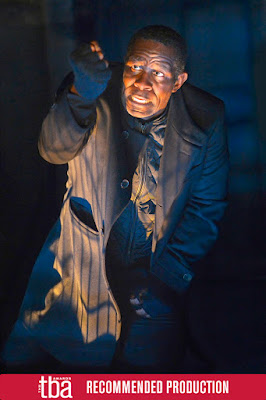
By A.C.T. Publications Staff Reviewers have lauded John Douglas Thompson’s performance in A.C.T.’s production of Hamlet . Charles McNulty of the Los Angeles Times says Thompson “shatteringly portrays the melancholy Dane” in a way that “heightens the plight of a character forced by treacherous circumstances to relinquish his youthful ideals.” The San Francisco Chronicle ’s Lily Janiak says “Thompson’s crisp and loving enunciation of every consonant” is a “testament to the power of classical training if there ever was one.” We sat down with the Tony Award–nominated actor to gain insight into his process as an artist and how he approached creating this demanding role. John Douglas Thompson in A.C.T.'s Hamlet . Photo by Kevin Berne. The character of Hamlet has almost 1,500 lines. How much of a challenge was this to take on? When I did Tamburlaine the Great , people would ask me, “Why are you doing it?” Here’s a play in which I had 1,700 lines, more lines than Hamlet, a ...

Intimate Yet Foreign: An Interview with Hamlet Scenic and Costume Designer David Israel Reynoso

Image
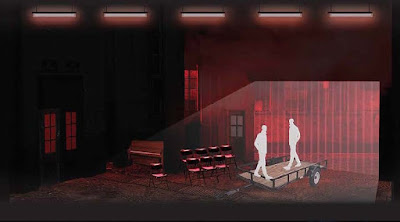
By Elspeth Sweatman and Simon Hodgson The Elsinore of A.C.T.’s Hamlet is a world swirling with rumor and falsehood. It’s filled with kings and courtiers who say one thing and do another. Scenic and Costume Designer David Israel Reynoso wanted the play’s set to reflect this duplicity. His vision incorporates majestic elements—towering walls and ramparts—but hints at the corruption embedded in Shakespeare’s text with heavy, abattoir-style sheeting through which we see images we can’t quite decipher. Is that Polonius we see hiding? Is it Claudius? “The space has a lot of partitions, nooks and crannies where people can spy on each other,” says Reynoso. “This idea that you don’t know where you are in relationship to anything and anyone is at the core of this play’s world.” We sat down with Reynoso to unravel some of the set’s secrets. Set rendering by David Israel Reynoso for A.C.T.'s 2017 production of Hamlet . This production of Hamlet is set in a world that is polluted, but...

“The Play's the Thing”: An Interview with Hamlet Director Carey Perloff

Image
By Simon Hodgson As a Fulbright Fellow at Oxford University, Carey Perloff saw her first performance of Hamlet and was hooked. “The draw was Shakespeare’s language,” she says. “It was unbelievably seductive.” For the next 30 years, she crossed continents to see imaginative new renditions of the classic: Peter Brook’s version in Paris starring Adrian Lester, Jonathan Goad at Stratford, Jude Law on Broadway, and Diane Venora at The Public Theater. In her final year as artistic director of A.C.T., Perloff takes on Hamlet for the first time. We sat down to get a glimpse into her process, her passion for Shakespeare, and the story of producing Hamlet at A.C.T. Hamlet Director Carey Perloff dicussing script edits with  A.C.T. D ramaturg  Michael Paller. Photo by Elspeth Sweatman. Why Hamlet now? As Jan Kott says in Shakespeare: Our Contemporary , Hamlet is a sponge that absorbs all that’s happening politically, socially, and spiritually in a culture. I read the...

“To Be or Not to Be”: The Iconic Speech’s Origins, Interpretations, and Impact

Image
By A.C.T. Publications Staff The opening line of Hamlet ’s “To be or not to be” soliloquy is theater’s most iconic, most referenced quote. What’s less known is the famous speech’s history, with Hamlet ’s earliest publications offering varying versions of its language. Also questioned is its meaning—is Hamlet contemplating suicide or is he weighing the consequences of murder? Though definitive answers are unlikely to arise, the questions “To be or not to be” asks have kept audiences, scholars, and actors engaged for centuries. Hamlet ’ s "To be or not to be" speech as it appears in the three original editions of the play. Photo by Georgelazenby. Courtesy Wikimedia Commons. The first edition, or First Quarto (Q1), of Hamlet was published in 1603. Because the text is much shorter than later editions and its language is less poetic, it is nicknamed the “Bad Quarto” by scholars. “To be or not to be” in Q1 reads as: To be, or not to be—ay, there’s the point. To die, ...