Posts

Showing posts with the label RobertLepage

Reinvention: Jean Cocteau in Needles and Opium

Image
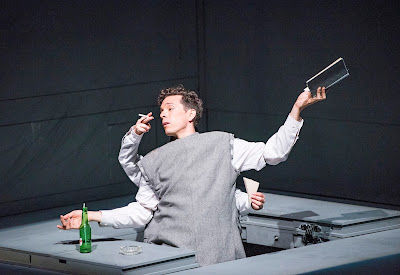
By Shannon Stockwell  When Needles and Opium creator Robert Lepage was first introduced to French writer, film director, and visual artist Jean Cocteau in the 1970s, he immediately recognized a kindred spirit. Here was another artist whose interest in the relationship between form and content mirrored his own. Olivier Normand in Needles and Opium . Photo by Tristram Kenton. From a young age, Jean Cocteau was entranced by all forms of art: painting, drawing, sculpture, writing of every kind, dance, opera, theater, and music. In 1909, Cocteau met Sergei Diaghilev, the manager of the iconic Ballets Russes. When Cocteau expressed interest in working with the ballet, Diaghilev responded, “ Etonne–moi .” (“Astonish me.”) Astonish is precisely what Cocteau spent his entire life trying to do. Until his death in 1963, he was a whirlwind of artistic activity as he attempted to impress and amaze. Although today he is best known for his filmmaking—he made six films over the cour...

Needles and Opium: The Backstage Pass

Image
By Simon Hodgson  While audiences have been dazzled by the onstage acrobatics of Needles and Opium , the backstage choreography demanded by this striking production is equally impressive. On a special behind-the-scenes tour for press and A.C.T. executive producers last Friday, three members of the Needles technical crew revealed some of the techniques and tools behind this extraordinary show. The tilted cube itself is 10-feet square, made of plywood panels on an aluminum frame. Tour Manager Charlotte Ménard said it weighs around three tons. It is powered by a 3000-watt step motor manufactured by Québec-based set design company Scène Éthique. The cube rotates on a central axis, with the motor running almost soundlessly. On the small platform built above the motor, Video Manager Thomas Payette makes sure the show is unfolding according to plan, with infra-red cameras tracking the movement of the cube and the crew and projecting the images onto his two monitors. When ...

Spirit of the Age: the Paris of Needles and Opium

Image
By Jess Katz In Needles and Opium , running at The Geary Theater through April 23, theater artist Robert Lepage weaves together the lives of Parisian filmmaker Jean Cocteau and jazz trumpeter Miles Davis. But he also populates the play with the spirits of Paris’s leading philosophers and artists. Simone de Beauvoir. Photo by Brassai, 1944. Courtesy Flickr. Simone de Beauvoir (1908–86) was the author of several works, foremost among them Le deuxième sexe ( The Second Sex , 1949), one of the foundational texts in second-wave feminist theory and criticism. Along with penning revolutionary treatises and authoring critically acclaimed fiction, de Beauvoir unapologetically broke with tradition in her personal life. She never married, never had children, nurtured a lifelong relationship with philosopher Jean-Paul Sartre, and had myriad lovers (men and women). Her intellectual appetite and her relationship with Sartre have cemented her status as a postwar Paris provocateur. ...

Addiction and Creativity in Needles and Opium

Image
By Shannon Stockwell  In Robert Lepage’s Needles and Opium —running through April 23 at The Geary Theater—we are confronted with a familiar image: a drug-addicted artist. But is there a connection between addiction and creativity? Olivier Normand as Jean Cocteau in Needles and Opium . Photo by Tristram Kenton. Many people initially assume that artists use drugs to enhance their creative abilities. Scientifically, there is some truth to this: drugs alter a person’s state of mind, leading them to stumble upon ideas they may not have developed while sober. But these substances can also severely inhibit a person’s ability to act on those new ideas. And sometimes, it turns out that the drug does nothing at all. Jazz trumpeter Miles Davis knew that drugs wouldn’t increase his creative capacity when he increasingly began using heroin in 1949. “I wasn’t never into that trip that if you shot heroin you might be able to play like Bird [Charlie Parker],” he says in his autobiograp...

The Music of Needles and Opium

Image
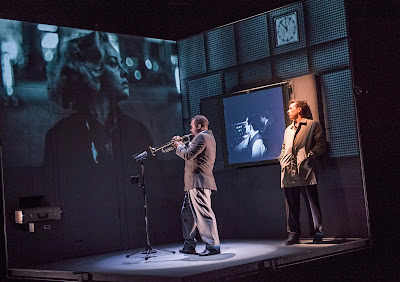
By Elspeth Sweatman  On March 30, the Prince of Darkness takes over The Geary. In Robert Lepage’s Needles and Opium , jazz trumpeter Miles Davis succumbs to the bliss and torment of heroin addiction, displacement, and love, only to rise again and create some of his most iconic music. Wellesley Robertson III (left) and Olivier Normand in Needles and Opium . Photo by Tristram Kento. The Davis we meet in Needles and Opium is a far cry from the global superstar that he became. In 1948, Davis was just 22 years old. He was a leading player in New York City’s 52nd Street jazz clubs and arrived in Paris with the Tadd Dameron Quintet to play in the Festival International de Jazz. In the city of light, Davis found that audiences were much more receptive to the quintet’s radical new form of jazz—bebop. Bebop was music for your ears, not your dancing feet. In contrast to the Dixieland style (popularized by swing bands during the 1930s), bebop was built on polyphony (each ...

Walking Down Walls: The Visual World of Needles and Opium

Image
By Shannon Stockwell A technological transformation is taking place on the Geary stage. Actors are putting on their harnesses and walking down the walls of a revolving cube in Robert Lepage’s Needles and Opium , which runs from March 30 to April 23 at The Geary Theater. Needles and Opium is an exploration of creativity, addiction, and loneliness. It follows the lives of jazz trumpeter Miles Davis, writer and filmmaker Jean Cocteau, and a lovesick man named Robert (based on Robert Lepage). As these tales interweave, projections swirl, the entire set revolves, and the actors burst out of the walls and floor. These technological and acrobatic feats are signature elements for Lepage, whose theatrical credits include two Cirque du Soleil shows. But they are not just for show. To Lepage, the spinning cube that makes up the main element of Needles and Opium ’s scenic design reflects the vertigo caused by opium, heroin, and love. The way the actors (Wellesley Robertson III and Ol...