Posts

Showing posts with the label TomStoppard

Visualizing Consciousness: The Hard Problem

Image
By Elspeth Sweatman Not only does Tom Stoppard’s newest play The Hard Problem —now playing at The Geary Theater through November 13—delve into the murkiness of consciousness and brain science, but it also presents a unique challenge for the set designer. How do you visualize consciousness? How can you represent it on the stage? “What I said to scenic designer Andrew Boyce was that I wanted the set to look like consciousness, not neuroscience,” says director Carey Perloff. “So we looked at the most beautiful science building that I think has ever been built: the Salk Institute in San Diego.” The Salk Institute. Photo by Justin Brown. Courtesy of Flickr. Built in the 1960s by architect Louis I. Kahn, the Salk Institute for Biological Studies is comprised of two mirror-image structures either side of a central courtyard. Made out of concrete and wood, these geometric structures create a temple of science on the shore of the Pacific. One of the institute’s most ...
Altruism versus Egoism in The Hard Problem

Image
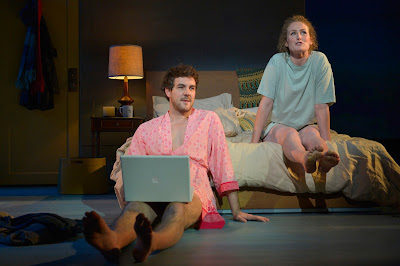
By Shannon Stockwell and Elspeth Sweatman “Since the very beginning, Tom Stoppard has written about what is the nature of goodness and is there such a thing as value ,” says The Hard Problem director Carey Perloff. “What are human values? How do we express ourselves as human beings? Is there such a thing as goodness, as altruism?” Altruism is at the center of Stoppard’s The Hard Problem , running at The Geary Theater through November 13. The term altruism—from the Latin alter , meaning “other”—was coined by French philosopher Auguste Comte in the nineteenth century. He wanted to create a religion based on a belief in science, rather than God. To Comte, to be altruistic meant simply to live for others. Dan Clegg and Brenda Meaney in A.C.T.'s 2016 production  of The Hard Problem . Photo by Kevin Berne. Since then, the concept of altruism and its counterpart, egoism, have become a hot topic of debate in a wide array of fields, from philosophy to biology to economics. The...

Strong Women: Hilary in The Hard Problem

Image
By Elspeth Sweatman Brenda Meaney as Hilary in A.C.T.'s 2016 production  of The Hard Problem . Photo by Kevin Berne. During A.C.T.’s 50th-anniversary season, strong women are navigating their way through traditionally male-oriented spaces. In Tom Stoppard’s The Hard Problem , running through November 13, psychologist Hilary Matthews fights to find her place in a scientific world that frowns upon the “feminine” emotions of mother love, goodness, and faith. Hilary is an oddity in neuroscience: a person who believes in the power of faith as well as the power of science. This worries her university tutor Spike, who fears that this will sink her chances of an academic career. “She has what he thinks are childish notions about the self, about consciousness, and about belief,” says director Carey Perloff. But Hilary’s faith is grounded in a pivotal event in her past: when she was a teenager, she gave up her baby for adoption. To cope, she turned to her faith in the ...

Breaking the Sound Barrier: An Interview with Voice Coach Nancy Benjamin

Image
By Simon Hodgson “Every single play that I pick up has its own accents,” says A.C.T.’s Co–Head of Voice and Dialects Nancy Benjamin. “The actors, the director, and the coaches have to figure out what that accent is and do it authentically.” Before she started working on Stoppard’s The Hard Problem —playing until November 13 at The Geary Theater—we sat down with Benjamin to talk about acting and accents. Nancy Benjamin works with M.F.A. Program actors Emily Brown, Alan Littlehales, and Albert Rubio. Photo by Alessandra Mello. How important are the accents in The Hard Problem as an identifier of character? Accents and dialects help us understand the culture of the play, the environment, the status of the characters, their education, their place of origin, and how they identify themselves. Specifically with The Hard Problem , once I understand where the character comes from, their age, and their level of education, then the accent or dialect comes from that. Our accents, our w...

Stoppard and Zombies: A.C.T.'s The Hard Problem

Image
By Elspeth Sweatman A zombie. By Pixabay. Courtesy of Wikimedia Commons. Imagine someone who looks exactly like you, dresses like you, walks like you. He says the same things you would say, answers questions with the same answers, and makes decisions using the same logic. His body is built in the exact same way. His brain is a mirror image of yours. The only thing he is missing is consciousness. Meet the philosophical zombie. When philosophers talk of zombies, they aren’t thinking of shuffling Halloween humanoids that will eat your brain. They mean something much more frightening. Something that’s being debated every night at The Geary, in A.C.T.’s production of Tom Stoppard’s The Hard Problem . If you met a philosophical zombie in the street, would you be able to tell the difference? Philosophers argue that you wouldn’t. But could these zombies be real? If they are real, then consciousness and the brain must be separate. And if that is so, then how did we get consciousness...

Mr. Hard Problem: An Interview with Philosopher David Chalmers

Image
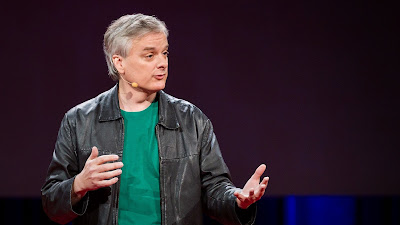
By Shannon Stockwell  Think of any modern philosophical theory about the mind, and Australian philosopher David Chalmers has probably had his hands on it. He is famous for coining the phrase “the hard problem” to describe the as-yet unanswered question of how a physical brain can create consciousness.  Philosopher David Chalmers. Photo courtesy of TED. Some aspects of consciousness are easy to explain. If you put your finger into the flame of a candle, your brain interprets that as pain, and you pull your finger away. But what about emotional pain, like sorrow, despair, and loneliness? What creates that? So far, scientists agree that consciousness exists, because we all experience it. But no one has been able to figure out where consciousness comes from. Is consciousness some kind of stuff that you could theoretically hold or see, coming from actual things happening in the body (like neurons firing)? Or is consciousness something else, something separate from the ...

Tom Stoppard on The Hard Problem

Image
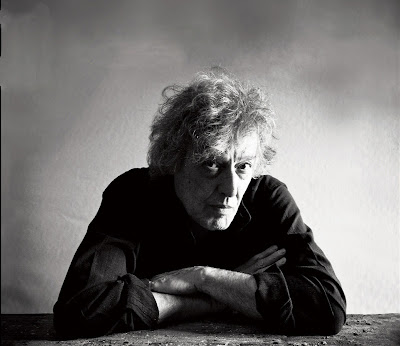
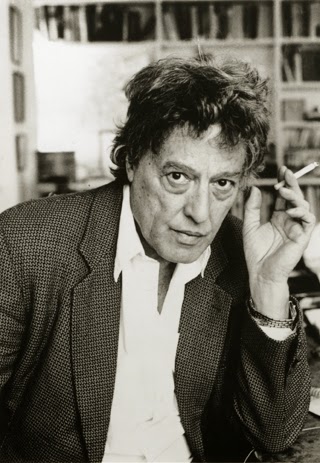
By Simon Hodgson  After 17 productions at A.C.T., Tom Stoppard has become part of Geary Theater lore. In these works, he has explored a wide range of topics, from philosophical paradoxes, political dissidence, and evolutionary biology to murder mysteries and landscape gardening. In between rehearsals for The Hard Problem —which runs through November 13—we caught up with Stoppard to talk about consciousness, computers, and chaos. Tom Stoppard. Photo by Matt Humphrey. In The Hard Problem , you focus on chaos and rationality, which affect both the stock market as well as Hilary’s intellectual exploration into consciousness. Why? For a long time during my intelligent years, from about 1950 to 1995, the computer was considered to be a paradigm for the human brain. A lot of people still think it is, and I found that I was resisting the idea. It seemed to me that the fact that the market behaves irrationally from time to time was an indication that it wasn’t controllable throug...

Stoppard and the Prisoner's Dilemma

Image
By Shannon Stockwell and Elspeth Sweatman  What do you get when you cross game theory with neurobiology? Tom Stoppard’s The Hard Problem , which runs at The Geary Theater from October 19 to November 13. In this play, Stoppard is particularly interested in the Prisoner’s Dilemma, a game theory scenario invented by Merrill Flood and Melvin Dresher in 1950. Let’s say John and Stacy both get arrested for the same crime. The sheriff goes to John and Stacy separately and offers them a chance to evade jail time if they betray their partner, while ensuring that John and Stacy cannot communicate with each other before making their decisions. Here are the possible results of that deal: Diagram of the Prisoner's Dilemma. Courtesy of A.C.T. Marketing Team. 1. If John betrays Stacy and says that she committed the crime, but Stacy stays silent, then John will get no time in prison, while Stacy will get three years. 2. If Stacy betrays John and says that he...

A.C.T. Kicks off 50th Anniversary with Two Special Events

Image
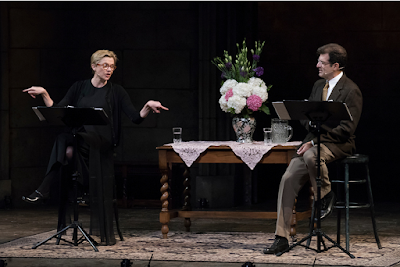
By Shannon Stockwell Annette Bening and Mark Harelik in Dear Liar 2016. Photo by Stefan Cohen. October has certainly gotten off to an exciting start at A.C.T.—you can really tell that our 50th anniversary is in full swing. In the span of two days, the Geary stage was graced by actors Annette Bening and Mark Harelik, playwright Tom Stoppard, and neuroscientist Linda Wilbrecht. On Sunday, October 2, Bening and Harelik joined up for a staged reading of Dear Liar , Jerome Kilty’s witty two-person play based on the letters between playwright George Bernard Shaw and his muse, Mrs. Patrick Campbell. The two actors have a long history with A.C.T.: Bening graduated from the Advanced Training Program (precursor to the M.F.A. Program) in 1983, and Mark Harelik was a company member in the ’80s. A.C.T. was thrilled to welcome them back for this reading, directed by Nancy Carlin, which they performed with a strong sense of sass in a performance that was free and open to our donors. A.C....

Love: Tom Stoppard's Preoccupation

Image
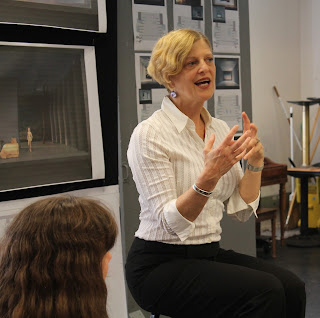
By Elspeth Sweatman A.C.T. Artistic Director Carey Perloff at the first rehearsal for The Hard Problem . Photo by Shannon Stockwell. "It's a fascinating thing to have a long, ongoing relationship with a writer," said A.C.T.'s Artistic Director Carey Perloff at the first rehearsal for Tom Stoppard's The Hard Problem . "What you realize is that everybody has their own life preoccupations, and they make art in order to try and wrestle with them." The Hard Problem is the eleventh Stoppard play Perloff has directed at A.C.T., giving her a unique perspective on this playwright's work. In her view, one of Stoppard's preoccupations is the nature of love. "In Arcadia , he toys with the way in which love is an anarchic emotion that spreads chaos amongst seemingly reasonable people. People don't always act in their own reasonable interests because love enters the universe, and then all hell breaks loose." "In this play, The...

Preparing for The Hard Problem with Tom Stoppard

Image
by Carey Perloff The grass, a shade of green unimaginable anywhere except on the British Isles, beckoned outside the window of Tom Stoppard’s extraordinary book-lined study in Dorset as we set off on two days of exhaustive work on his new play The Hard Problem , which we’re bringing to A.C.T. this fall. Tom Stoppard and Carey Perloff What continues to amaze me about Stoppard, with whom I have worked nearly a dozen times now, is his willingness to rewrite, reimagine, rethink, while always staying absolutely true to his own voice and his first instincts. Over a long weekend in Dorset, we went through every line of The Hard Problem , trying to tease out the balance of science and faith, intellect and instinct. I was wrestling with the character of Spike and what he actually felt for the protagonist, Hilary; Tom hilariously tried to explain to me the difference between a bed partner and a boyfriend, and argued for the obsessive love of science which seems to cloud the rest of Spike...

Tom Stoppard at The Strand

Image
by Simon Hodgson Many thanks to everyone who filled The Strand on Sunday for the reading of Tom Stoppard’s The Hard Problem . It was great to see so many people showing up for our Scripts Play Reading Series . Aside from the pleasure of hearing Stoppard performed by an all-star cast, it was a treat to see several favorite faces from other A.C.T. shows. On Sunday, The Hard Problem cast included actors from no fewer than four of this season’s mainstage productions: Rinabeth Apostol from Monstress ; Ramiz Monsef, currently starring in The Unfortunates ; David Strathairn from the upcoming Chester Bailey ; and Rod Gnapp, James Wagner, Rebecca Watson, and Allison Jean White—all currently appearing in The Realistic Joneses at The Geary. Ramiz Monsef, Allison Jean White, and David Strathairn appearing in A.C.T.'s Scripts Play Reading Series for Tom Stoppard's The Hard Problem . Photo by Cecilia Padilla. One of the amazing things about coming regularly...

Tom Stoppard and the Inspiration behind Indian Ink

Image
By Shannon Stockwell Tom Stoppard (photo by Amie Stamp) Tomáš Straüssler was born in 1937 in Czechoslovakia, and he arrived in India as a refugee when he was four years old. He lived there from 1942 to 1946, and he learned English while attending a school in Darjeeling run by American Methodists. While in India, his mother met Kenneth Stoppard, a major in the British Army, who brought the whole family back to his home in Derbyshire, England. His mother and Major Stoppard married, and Tomáš adopted the name he uses today. Stoppard did not enjoy school and dropped out when he was 17, taking a job at the Western Daily Press , a newspaper in Bristol. He hoped to pursue a career in journalism, but while working as a critic, he fell in love with the theater. His first play, A Walk on the Water , introduced him to the agent Kenneth Ewing, who provided Stoppard with the inspiration for Rosencrantz and Guildenstern Are Dead . The National Theatre in London produced Rosencran...

Dreaming in Color

Image
An Interview with Costume Designer Candice Donnelly By Shannon Stockwell From the many hues of rasa to the festival of colors known as Holi, Indian culture is marked by a love for vibrancy that is truly ancient. For a play set in India, especially one centered around poetry and art, the visual design vocabulary is of the utmost importance. A.C.T.’s production of Indian Ink is in the capable hands of costume designer Candice Donnelly, whose work has brought her to almost every corner of the world, from Broadway to Buenos Aires to Hong Kong. Previously at A.C.T., she has created costume designs for Elektra , Endgame and Play , ’Tis Pity She’s a Whore , The Circle , and Happy End . We spoke with Donnelly to find out what is behind her costume design and how she created the visual world of Indian Ink . Costume rendering for Flora Crewe,  by costume designer Candice Donnelly. What appeals to you artistically about Indian Ink ? The play has an elusive quality rega...

Meet Adam O'Byrne, who plays Valentine Coverly in Arcadia

Image
Name: Adam O'Byrne Role: Valentine Coverly Adam O'Byrne Arcadia  runs through June 16. Learn more about the production and order tickets. What are your preshow/postshow rituals? I like to have a cup of Lady Grey tea before the show and a chat with my dressing room roommate, Nick Pelczar [who plays Ezra Chater], after the show . . . occasionally we toast our work with an adult refreshment. What is your favorite thing about San Francisco? Walking to work. I live in L.A., so just being able to walk this city is wonderful. If you could live during a different cultural period, what period would it be and why? I'd like to visit a lot of different periods: Elizabethan England and Ancient Greece, to name a couple. But I like living in the here and now! What was your favorite discovery during the rehearsal process for Arcadia ? I was happy to discover the nuances of the Val/Hannah relationship. How they communicate, the depth of the feelings between them,...

Meet Rebekah Brockman, who plays Thomasina Coverly in Arcadia

Image
Name: Rebekah Brockman Role: Thomasina Coverly Rebekah Brockman Arcadia  runs through June 16. Learn more about the production and order tickets. What are your preshow/postshow rituals? Preshow: I never step foot onstage without a splash of my mum's perfume (it reminds me of home), but this show I am wearing a perfume Allegra Edwards [who plays Chloë Coverly] gave me since it is our last show together.
Postshow: A nice cold drink . . . lately it has been a Black & Tan. What is your favorite thing about San Francisco? When I am able to go home and watch the sun set and hear the fog horns from the ships coming in. If you could live during a different cultural period, what period would it be and why? I think I would choose sometime in the distant future. I am curious to see what is built upon the foundation we are creating today. What was your favorite discovery during the rehearsal process for Arcadia ? Honestly, my favorite discoveries come from being with...

Meet Gretchen Egolf, who plays Hannah Jarvis in Arcadia, and learn her tips for speaking with a British accent

Image
Name: Gretchen Egolf Role:  Hannah Jarvis Gretchen Egolf Arcadia runs through June 16. Learn more about the production and order tickets. What are your preshow/postshow rituals?  I warm up, have a cup of tea, and brush my teeth. And when possible, I really like to stand where I can hear the audience and listen to them a bit before the show. Or even peep out and look at them when possible! It helps me identify more specifically who I'm doing this for and who will be sharing in this with me. What is your favorite thing about San Francisco?  I don't know yet! Now that the show has opened I'll actually get to see more of it. So far my favorite thing is this theater.   If you could live during a different cultural period, what period would it be and why? In the Western world, I think the turn of the (last) century was a fascinating time. In psychology, society, art . . . huge changes.   What was your favorite discovery  during the rehearsal...

“I Have an Orchestra!”

Image
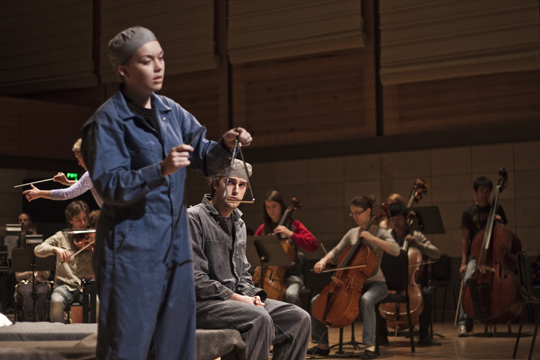
A.C.T.’s M.F.A. Program Students Discuss Every Good Boy Deserves Favour  Tom Stoppard and André Previn’s Every Good Boy Deserves Favour premiered in London as part of Queen Elizabeth II’s 1977 Silver Jubilee. Stoppard’s political play about government repression of free speech isn’t exactly jubilant, but it does have a certain majesty. EGBDF (the title is a mnemonic device for remembering the notes of the treble clef on a musical staff) calls for an onstage orchestra that is an integral participant in the performance; the original production featured Ian McKellen, Patrick Stewart, John Wood, and the entire London Symphony Orchestra. The play’s protagonist, Alexander Ivanov, has published allegations that the Soviet government imprisons its political enemies in mental hospitals; for this, he is “diagnosed” with paranoid delusions and sent to a mental hospital himself. His cellmate, also named Alexander Ivanov, is genuinely ill; he thinks he has his own orchestra, in which he i...