Posts

Showing posts with the label SatchmoAtTheWaldorf

Behind the Scenes at A.C.T.: An Interview with Head Carpenter Miguel Ongpin

Image
By Elspeth Sweatman It’s easy to spot Miguel Ongpin, A.C.T.’s Head Carpenter. Just look for his signature orange baseball cap or listen for his booming laughter. When in doubt, head towards his shrine: a collection of posters—including John Sayles’s Lone Star —that Ongpin brought to liven up his backstage kingdom. Head Carpenter Miguel Ongpin. Photo by Elspeth Sweatman. Before a performance of Battlefield , we sat down with Ongpin to get some insight into the life of a theater’s stagehand and carpenter. How did you get into theater? I had fun doing the productions in high school, whether that was being in them or helping backstage. So I thought, “Oh, that’s a good way to meet people in college.” So I did it in college at UC Berkeley. I acted—ha!—in a couple plays, and then I stage-managed a bunch of plays. The guy who ran the theater told me, “If you really want to make money and do theater, you become the stagehand. At least we always work.” [ laughs ] So after co...
An Award Fit for a Prince: Tony Award Nominee John Douglas Thompson

Image
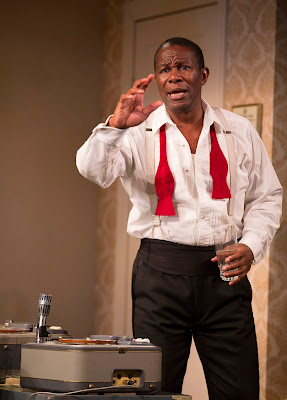
By Elspeth Sweatman Actor John Douglas Thompson in Long Wharf Theatre's 2012 production of Satchmo at the Waldorf . Photo by T. Charles Erickson. Our Prince of Denmark is nominated for a Tony Award! Before he returns to The Geary Theater to open A.C.T.’s 2017–18 season with Hamlet on September 20, John Douglas Thompson is up for a Tony for his performance as Becker in August Wilson’s Jitney on Broadway. For Thompson, the preparation for a part is the same, whether it is written in Wilson’s lyrical dialect or Shakespeare’s iambic pentameter. “I look for characters that have an Achilles heel that the character is conscious or unconscious of,” says Thompson. “Then I look for a catharsis that gives the character some evolution. Once I’ve found that, I start upon a course of rigorous research. If it’s a Shakespeare play, I read all the different editions and adaptations of that play, and I also study other productions to see what other people have done.” Thompson’s p...

The American Sound: The Evolution of Jazz

Image
By Cecilia Padilla There is nothing so uniquely American as jazz music. In its simplest form, jazz embodies the essence of the American people: bold and inventive. The improvisation of the jazz ensemble can even be seen as a metaphor for the American democratic ideal: musicians playing solos have the liberty to express themselves as long as they adhere to the overall structure of the tune—individual freedom but with responsibility to the group. The evolution of jazz music also carries with it the social development of our nation from slavery to the swinging songs of World War II. Musically, jazz contributed immensely to the way contemporary musicians approach instrumentation, composition, and vocal arrangements. It is difficult to find a popular tune today that does not derive from such jazz icons as Joe Oliver, Louis Armstrong, Duke Ellington, and Thelonious Monk. Jazz is the great equalizer; for more than a hundred years, it has been the common ground between blacks and whites, me...

A Hell of a Businessman: A Biography of Joe Glaser

By Simon Hodgson Born in 1897, Joe Glaser was the son of a successful Russian Jewish physician in Chicago. He originally intended to follow a similar career and entered medical school, but after passing out in the operating room, he realized he wasn’t cut out to be a doctor. He started off in business selling used cars, but found better luck managing prizefighters. In his biography of Al Capone, Laurence Bergreen notes, “Glaser’s power to fix fights earned him a reputation as a sage of boxing, especially among reporters.” With advanced word as to which fights were fixed, Glaser could predict the results—and even the number of rounds—of many bouts in Chicago. His connections with organized crime continued in his next career change, when he began running nightclubs and whorehouses in the South Side for the Chicago Outfit, the powerful underworld gang led by Capone. Glaser’s tendency toward illegal action nearly ended his career. In 1928, he was sentenced to ten years in prison for ...

A Trick of Lighting: An Interview with Scenic Designer Lee Savage

Image
By Michael Paller Scenic designer Lee Savage has worked at regional theaters across the country and has extensive credits in New York City. He joined the creative team for Satchmo at the Waldorf in 2011 and has been with the crew ever since. “I love working on one-person shows,” says Savage. “It’s a very intimate experience.”  We spoke with Savage about the challenges and exciting discoveries that have come from designing Satchmo at the Waldorf .  What sparked your interest in designing Satchmo ? I had been approached by [director] Gordon [Edelstein] to do it, and I had never worked with him before, so I was very excited by the opportunity. After reading the play, I was really thrilled by its theatricality. Not only the biographical aspects of Louis Armstrong and his manager, Joe Glaser, and their relationship, but how they were being embodied by one actor. There’s an innate theatricality and awesome skill that only actors have: they can transform not only from who th...

From Reel to Real: Louis Armstrong and Personal Recording

Image
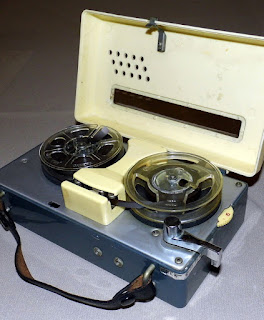
By Simon Hodgson  For Louis Armstrong, a man who experienced the world through sound, recording himself came naturally. When commercially manufactured reel-to-reel tape recorders became available in the late 1940s, Armstrong was an early adopter. He was introduced to the new machines by his friend Bing Crosby, who saw the value in the magnetic tape technology exported from post–World War II Germany. The trumpeter invested in a Recordio reel-to-reel tape machine manufactured by Wilcox-Gay Corporation and took the bulky device with him on the road, transporting it in a steamer trunk. While Crosby went on to use reel-to-reel tapes professionally and revolutionized broadcasting (he prerecorded radio shows rather than performing live), Armstrong used the new equipment in a more personal way. Initially, Armstrong used the audio technology to record his stage performances, enabling him to listen to and polish his sets. Gradually, however, he started recording ordinary life as well. H...

A Major-Key Artist: An Interview with Playwright Terry Teachout

Image
By Shannon Stockwell It is a Sunday evening in 1964. An eight-year-old boy plays in the backyard of his small-town Missouri home. His mother leans out the door and tells him to come in. When he walks inside, he sees that the television is on. His mother says, “I want you to watch this. I want you to see this man, because he won’t be around forever.” On the screen are Louis Armstrong and His All Stars, playing “Hello, Dolly!” on The Ed Sullivan Show . The young boy is entranced. This is Terry Teachout’s first memory of the music of Louis Armstrong. Teachout later went on to become a jazz musician, the theater critic for the Wall Street Journal , the author of Pops: A Life of Louis Armstrong , and the playwright of Satchmo at the Waldorf . We caught up with Teachout to talk about the inspiration behind his first play, the complexity of Louis Armstrong, and the pure joy of Satchmo’s music. What is it about Armstrong’s relationship with his manager Joe Glaser that is ripe for the s...

Cool versus Fool—Criticisms of Louis Armstrong

Image
By Shannon Stockwell In the beginning of his career, Louis Armstrong successfully walked the thin line between art and entertainment. His jazz recordings with the Hot Five were regarded as some of the most influential in music history, but at the same time, the records contained enough of his comedy and his distinctive singing to attract those who weren’t jazz aficionados. By the end of the 1930s, however, it was clear that Armstrong’s music was decidedly pop oriented. As he grew more popular with mainstream audiences, jazz scholars turned up their noses at him. Among these purists, the consent was that Armstrong didn’t have the same technical proficiency that he once did, his repertoire was stale, and he gave up musicality for mainstream entertainment value.             Around the 1940s, young black jazz musicians who had once admired Armstrong found themselves with similar criticisms, but they believed Armstrong h...