Posts

Showing posts with the label ElspethSweatman

Director Tamilla Woodard on Top Girls (Part Two)

Image
By Elspeth Sweatman  A year after bringing the rip-roaring adventure  Men on Boats  to the Strand, Director Tamilla Woodard is back at A.C.T. with Caryl Churchill’s 1982 play  Top Girls . Director Tamilla Woodard (left) and A.C.T. Artistic Director Pam MacKinnon (right) discuss  Top Girls . Photo by Claire L. Wong. What’s your process as a director? Do you like to do research? Any play I do, I go as deep as I can. Of course, I think that’s simply part of the job. The more you dig, the more you find and the more you find, the more you need to keep looking. I want to surround myself with as many tools as I can, not out of studiousness but to communicate about the play. First and foremost, I need to satisfy my questions so I go until I run out of time [ Laughs ] which 99.9 percent of the time is what happens. All of that is fuel for my imagination and decision-making. One of the things that I do with a play is I sit down and write just pages and pages...


Director Tamilla Woodard on Top Girls (Part One)

Image
By Elspeth Sweatman A year after bringing the rip-roaring adventure Men on Boats to the Strand, Director Tamilla Woodard is back at A.C.T. with Caryl Churchill’s 1982 play  Top Girls . Director Tamilla Woodard describes her vision for Top Girls . Photo by Claire L. Wong. Men on Boats , which you directed last fall at the Strand, upended stereotypes, and in a way, Top Girls is doing something similar. These are powerful female characters, but they are all still trapped inside the patriarchy.  They are responding to the invisible presence of men. It’s like there are only women onstage but there’s a big man head hanging above them, looking down at them. [ Laughs ] Jaclyn [Backhaus] tackled stereotypes in Men on Boats by having no men and no mention of the fact that these female-identified bodies were playing men; men disappeared entirely. Here, no men appear onstage but man-ness is ever present. Masculinity is present. Patriarchy is present. These women are under t...

Join the Crash, Embrace the Herd

Image
By Elspeth Sweatman A crowd. Photo courtesy Pxhere.   Like it or not, humans are herd animals. From the moment we are born, we crave interaction, communication, affection. To achieve these needs, we accept rules and traditions that help us to fit in, get along, and stay safe. Yet, we also know how dangerous going along with the group can be. Our news reels and Netflix queues are full of examples of innocent bystanders being duped, injured, or killed because they followed others. How can herd mentality be both the bedrock of our civilization and its undoing? There are two types of herding: self-interested (when we copy the motivations and actions of others for our own gain) and collective (when we imitate others for the advantage of the entire group). When we go to a Giants baseball game at Oracle Park and follow the crowd to the entrance, that’s self-interested herding; we assume people know where they are going. When we stand on the right-hand side of escalators to let ot...

I Am Nigerian. I Am American. I Will Not Choose.

Image
By Elspeth Sweatman A.C.T. Master of Fine Arts Program alum Mfoniso Udofia is taking the American theater by storm. Her current project is the Ufot Family cycle, a series of nine plays exploring a family of Nigerian immigrants in America. The cycle has been workshopped at leading new-play incubators, including SPACE on Ryder Farm and Dr. Barbara Ann Teer’s National Black Theatre. Three of the plays— Sojourners , runboyrun , and Her Portmanteau —have been produced at The Playwrights Realm, Magic Theatre, and New York Theatre Workshop. Now, she is back at A.C.T. with Her Portmanteau . After 22 years apart, Nigerian-born Iniabasi Ekpeyong—bearing a worn portmanteau—reunites with her mother and half-sister in Manhattan. This coming together isn’t easy. The women must sort through their literal and figurative baggage as they uncover their personal and familial identities. We chatted with Udofia about the Nigerian American identity and the importance of having Black bodies onstage. Sce...

Learning What Living Was All About

Image
By Elspeth Sweatman Born on March 12, 1928, and adopted by Reed A. and Frances C. Albee—two members of the elite in Larchmont, New York—Edward Franklin Albee III had a coddled but lonely childhood. His parents bought him everything he could have ever wanted: Grenadier Guard toy soldiers, electric trains, a smoking jacket. He went to see Broadway shows and spent the winter months in Palm Beach, Florida. But material possessions and a lavish lifestyle could not hide the fact that his parents were unloving. “Whenever his mother became angry with him, she reminded him that he was adopted,” says biographer Mel Gussow. “The inference was in the air that, if he did not behave, if he did not measure up, he could be returned to the orphanage, like an unwanted possession.” Edward Albee in 1971. Photo courtesy Cleveland State University. From an early age, Albee knew he wanted to be a writer. He began drafting poems at six, plays at 12, and novels in his teens. Albee’s dedication to his ...

Three (and a Half) Pulitzer Prizes

Image
By Elspeth Sweatman “You either affect people or you leave them indifferent,” said playwright Edward Albee (1928–2016). “And I would loathe to leave an audience indifferent. I don’t care whether they like or hate, so long as they’re not indifferent.” They weren’t. Albee’s unique, provocative brand of truth-telling did not always sit well with audiences and critics, but it secured his place in the American theatrical pantheon. In fact, Albee earned three—or as he was fond of saying, three and a half —Pulitzer Prizes for Drama. Playwright Edward Albee. Photo courtesy University of Houston Photographs Collection. 1963: Who’s Afraid of Virginia Woolf? Albee made a splash with his first full-length play, Who’s Afraid of Virginia Woolf?, and its iconic, warring couple: George and Martha. Showing off Albee’s wit and bite, the games that George and Martha play to entertain their guests are amusing at first, but we quickly see that they are designed to put everyone on edge, incl...

Old Friends, New Friends: Actor Sharon Lockwood on Returning to A Christmas Carol

Image
By Elspeth Sweatman and Annie Sears Christmas may have passed, but the holiday spirit is still thriving here at A.C.T. Many members of the A Christmas Carol cast and crew have made this performance an integral part of their holiday tradition, including actor Sharon Lockwood, who plays Mrs. Dilber and Mrs. Fezziwig. Lockwood has performed at A.C.T. for nearly 30 years, including 14 seasons of A Christmas Carol . We sat down with Lockwood to hear more about what it’s like to integrate a familiar role into an ever-changing cast. James Carpenter as Scrooge and Sharon Lockwood as Mrs. Dilber in A.C.T.'s 2017 production of A Christmas Carol . Photo by Kevin Berne. How does it feel to return to the same role every year? Like getting in touch with an old friend?  Old friends? Yes! It's so nifty to play two wildly different characters back and forth in the course of a show, even changing make-up in between. Dominique [Lozano], our director, is always coming up with ways to fi...

A Good Old Coat: Actor Cindy Goldfield on Returning to A Christmas Carol

Image
By Elspeth Sweatman and Annie Sears A Christmas Carol is a classic story, one many of us know well. But actor Cindy Goldfield may know it best. She's played or understudied all the adult female roles in A.C.T.’s adaptations—from Mrs. Fezziwig to Mrs. Cratchit to the Ghost of Christmas Present. She most often plays Charitable #1, a role she loves because of its dynamic story arc. As Goldfield prepared to return to this cherished character, she shared about how the often-told story retains its sense of newness. Cindy Goldfield as Charitable #1, James Carpenter as Scrooge, and Howard Swain as Charitable #2 in A.C.T.'s 2017 production of A Christmas Carol . Photo by Kevin Berne. How does it feel to return to the same role year after year? It feels like a good old coat. It’s the same role, but it's magical how different it feels year to year. The sets, text, costumes, lighting, sound, people, and director may be close to exactly the same, but somehow it always fee...

We Broke Many Oars and Most of the Ten Commandments: The Famous 1869 Expedition Staged in Men on Boats

Image
By Elspeth Sweatman Graphic by Sasha O'Malley. Four boats. Ten men. Ninety-nine days. One thousand miles. John Wesley Powell’s expedition through the canyons of the Green and Colorado Rivers—which Playwright Jaclyn Backhaus has staged in Men on Boats —has gone down in history as one of the defining heroic narratives of the American West. Yet, when he and his crew set off from Green River Station in the Wyoming Territory on May 24, 1869, they were unknown, and more hodgepodge than heroes. No one—except for Powell—had any river-running experience. The expedition had no federal funding, and there was very little attention from the press. As the explorers looked downstream on that first day, they wondered just what they had gotten themselves into. Would they encounter waterfalls taller than Niagara or boulders the size of houses? Would their days be filled with a never-ending onslaught of rapids or become a tedious slog through almost still water? And looming in the back of ...

A Mini King Lear: Actor James Carpenter on Preparing for A Christmas Carol

Image
By Elspeth Sweatman and Annie Sears The 12 days of Christmas? For actor James Carpenter, it’s more like the 12 years of A Christmas Carol . This will be his 12th year gracing the Geary stage as tightfisted Ebenezer Scrooge. Carpenter has frequented A.C.T. stages for nearly 20 years, from Glengarry Glen Ross (2001) to Rock ’n’ Roll (2008) to Heisenberg (2018), and he’ll be playing Charlie in Edward Albee’s Seascape this coming January. But first, he returns to Scrooge. We recently sat down with Carpenter to hear about his intimate knowledge of this iconic character. James Carpenter as Scrooge and Sharon Lockwood as Mrs. Dilber in A.C.T.'s production of A Christmas Carol (2017). Photo by Kevin Berne. How does it feel stepping back into the role of Scrooge? Does he feel like an old friend? I don’t know that I’d call Scrooge an old friend. A mutual combatant, perhaps. A role I know I’m going to have to gird my loins for and ready myself to take on. This year, Anthony Fusc...

Rereading the Book, Revisiting the Role: Actor Anthony Fusco on Preparing for A Christmas Carol

Image
By Elspeth Sweatman and Annie Sears The holiday season is a time of traditions: hot chocolate and candy canes; humming the same tunes and baking the same treats; feasting and exchanging gifts with family and friends. For some—such as actor Anthony Fusco—A.C.T.’s Christmas Carol is a large part of the holiday ritual. Fusco is an A.C.T. regular, having appeared in over 35 mainstage productions. He’s been involved with A Christmas Carol for the last 17 years, first playing Bob Cratchit in the Dennis Powers and Laird Williamson adaptation. After A.C.T. transitioned to Paul Walsh and Artistic Director Emerita Carey Perloff’s adaptation, James Carpenter assumed the role of Scrooge and Fusco was his understudy. “That first year, I went on when Jim got sick, having never rehearsed the role onstage!” says Fusco. “That was exciting !” The role is demanding, as Scrooge never leaves the stage. So Fusco and Carpenter now share the part. We recently sat down with Fusco to hear about what it’...

Insight into Sweat: An Interview with Director Loretta Greco

Image
By Elspeth Sweatman Director Loretta Greco explains the design team's vision at the Sweat Meet and Greet. When A.C.T.’s new artistic director Pam MacKinnon asked Loretta Greco—artistic director of the Magic Theatre—to direct playwright Lynn Nottage’s Sweat , Greco immediately said yes. She felt the power of the Pulitzer Prize–winning drama when it premiered at the Oregon Shakespeare Festival in 2015, and knew she wanted to explore it further. We sat down with Greco as design plans were being finalized to discover what it is about Nottage’s work and The Geary Theater that excites her. Sweat will be your fifth play for the Geary stage. What ’s special about this space? The thing about The Geary is there are plays where you want to take advantage of the pomp and circumstance, and then there are plays where you need the immediacy. Sweat requires immediacy. The characters are a family, and that bar is like their living room. We want to extend that so the audience feels that ...

Insight into Sweat: The Dramatic Appeal of Bars

Image
By Elspeth Sweatman A mug of beer. Photo courtesy Max Pixel. Whether writing a slapstick comedy, a sci-fi action flick, or a tense family drama, writers for both stage and screen have been drawn to bars. The bar in Lynn Nottage’s Sweat (which starts previews at The Geary on September 26) is an excellent example. Most of the play takes place in a bar; it’s where mill workers spend their time between shifts. So why would Nottage—and so many other storytellers—choose this setting? What does the presence of alcohol add dramaturgically to a story? Often nicknamed the truth-telling serum, alcohol affects the brain’s prefrontal cortex, where rational thought and decision-making occur. For storytellers, this creates moments of incredible humor—take actors Stockard Channing, Sandra Bullock, Nicole Kidman, and Dianne Wiest howling with laughter and calling each other “witch” after downing too many midnight margaritas in the film Practical Magic (1998)—but also moments of unforgettable ...

Insight into Sweat: Camaraderie in a Company Town

Image
By Elspeth Sweatman   Downtown Reading, Berks County, Pennsylvania, April 2011. Photo by Nicholas A. Tonelli. Courtesy Flickr.   Lynn Nottage’s Sweat is set in the nonfictional town of Reading, Pennsylvania, a town built around a single steel company. These tight-knit communities have a distinct rhythm. Dominated by one industry, their days are punctuated by shift bells and post-work drinks, and their years by the economic wheel of fortune: prosperity followed by layoffs, strikes by compromises. From this rhythm comes a unique psychology that pervades the community, impacting the lives of mill workers and non-mill workers alike. Every business and every resident has some connection to the industry. Everyone is part of the cycle of boom, bust, and boom again. It is this aspect that has made the mill closures in America’s Rust Belt over the past three decades so devastating. Riveting, jacking, stoking, drilling: these a...

Walking in Their Shoes: An Interview with Suns Cultural Consultant Humaira Ghilzai

Image
By Elspeth Sweatman For everyone on the team at A.C.T., accurately portraying Afghan culture onstage is an essential part of telling the story of A Thousand Splendid Suns . “True-to-life characters and scenes are forged from an understanding of why people act in certain ways: how their geography, culture, upbringing, and history drive their thoughts and actions,” says cultural consultant Humaira Ghilzai, who joined the Thousand Splendid Suns team for the world premiere in 2017 to help A.C.T. achieve their goal of authenticity. “The main role of a cultural consultant,” she says, “is to bring cultural literacy to a project in order to create an authentic portrayal of Afghan people, their customs, and their languages.” During the development of A Thousand Splendid Suns , we spoke with Ghilzai to get her insight into Afghan culture. Cultural consultant Humaira Ghilzai. Photo by Sutter Morris. What does a typical Afghan family look like? In general, an Afghan family consists ...

A Celebration of A.C.T. Artistic Director Emerita Carey Perloff

Image
By Elspeth Sweatman Over the past year, theater-makers and arts reporters have written about Artistic Director Carey Perloff and her 25-year tenure at the helm of A.C.T. They’ve focused on her herculean efforts to rebuild The Geary Theater after the 1989 earthquake and her work to refurbish The Strand Theater in 2015. They’ve chronicled her tenacity in commissioning new American translations of classic plays, her international collaborations, and her creative partnerships with Harold Pinter and Tom Stoppard. But these achievements only illuminate one side of this director, storyteller, teacher, and collaborator. Now, it’s our turn to celebrate our energetic, industrious leader for the Renaissance artist that she is. A.C.T. Artistic Director Emerita Carey Perloff.  Photo by Drew Altizer. Carey’s love for the city A.C.T. calls home is evident in the numerous Bay Area stories that she has championed, including After the War , The Tosca Project , and Armistead Maupin’s Tales...

1969 Facts and Trivia

Image
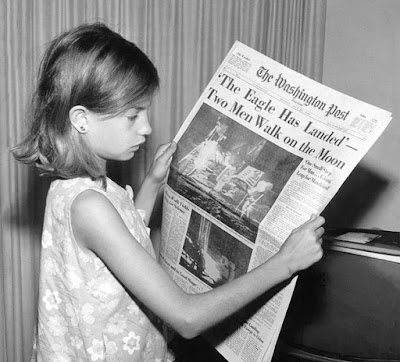
By Elspeth Sweatman From the cost of a gallon of milk to the top radio hits, here are some facts and figures about the year that inspired the story of A Walk on the Moon —1969! A young girl reading the Washington Post , July 21, 1969. Photo by Jack Weir. Courtesy Wikimedia Commons. US President Richard M. Nixon Population San Francisco: 715,600 United States: 202,676,900 World: 3,609,000,000 Cost of Living Value of today’s dollar: $6.94 Average income: $8,550 per year Minimum wage: $1.60 per hour Average new car: $2,000 Gallon of gas: $0.35 Average house: $27,900 Gallon of milk: $1.10 Dozen eggs: $0.62 Pound of sugar: $0.12 Black-and-white television: $125 Color television: $800 Autographed posed publicity photo of Barbra Streisand for 1969 film Hello, Dolly!  Courtesy Wikimedia Commons. Top-Grossing Movies 1. Butch Cassidy and the Sundance Kid 2. Midnight Cowboy 3. Easy Rider 4. Hello, Dolly! 5. Bob & Carol & Ted & Alice...

The Summer of ’69: A Snapshot of America

Image
By Elspeth Sweatman Looking back, the summer of 1969 seems idyllic. A hamburger cost 10 cents, a gallon of gas, 35. But throughout those dog days, a sense of revolution was sweeping the nation. On the streets, beehive hairdos were giving way to tie-dye shirts and bell-bottom jeans. On the airwaves, girl groups were competing with rock ’n’ roll and protest anthems. On television, Bonanza was followed by footage of the Vietnam War. Like Pearl and Alison in A Walk on the Moon , many Americans felt they were on the cusp of radical change. Here’s a snapshot of America in that life-changing year. Astronaut Buzz Aldrin salutes the US flag. Photo by Neil Armstrong/NASA. Courtesy Wikimedia Commons. Burning Draft Cards On June 27, Life magazine published photos of the 241 American soldiers killed in Vietnam during a one-week period. The public response was immediate, visceral, and divided. By 1969, US armed forces had been in Vietnam for almost 15 years. Although most Americans ini...

The Sound of the ’60s: An Interview with A Walk on the Moon Composer and Lyricist Paul Scott Goodman

Image
By Elspeth Sweatman From his early days growing up in a Jewish family in Glasgow, Scotland, composer and lyricist Paul Scott Goodman dreamed of combining his two passions: musical theater and rock ’n’ roll. After playing in punk bands in Glasgow and London, Goodman moved to New York City in 1984 to make his dream a reality. Drawing inspiration from pop pianist Elton John, punk rocker Johnny Rotten, and Broadway stalwarts Jerry Block ( Fiddler on the Roof ) and Stephen Sondheim ( West Side Story , A Little Night Music ), Goodman fused these genres to create a sound uniquely his own. Now, Goodman is melding his rock ’n’ roll, singer-songwriter sound with his Jewish roots for A.C.T.’s Walk on the Moon . We caught up with Goodman to get a behind-the-scenes look at a song’s journey from its first chords to the Geary stage. Composer and lyricist Paul Scott Goodman. Courtesy Paul Scott Goodman. Why did you want to get involved with this project? Sometimes you just hear of an...