Posts

Showing posts with the label 2018–19Season

Snail Slime and Other Secrets: 'Great Leap' Actors Reveal Their Pre-Show Routines

Image
By Annie Sears Being an actor means a lot of preparation: researching the play’s context and analyzing character motivations, attending costume fittings and spending hours in blocking rehearsals. Another important prep step not often revealed? Pre-show skincare. Stage makeup is heavier than day-to-day makeup, often causing allergic reactions, breakouts, and dryness—which nobody wants, especially someone who stands under stage lights every day. So how are actors in  The Great Leap  (running through March 31 at The Geary) making sure their faces are stage-ready? BD Wong (playing Wen Chang) is a fan of hyaluronic acid. Sounds a little scientific and sterile—like something you definitely do  not  want soaking into your skin, right? It’s actually entirely natural. Our skin cells produce hyaluronic acid on their own, but we could all use a little extra to even skin tone and decrease the appearance of lines and wrinkles. “It makes it possible for this character to be ...

Behind the Scenes at A.C.T.: An Interview with Head Stage Manager Elisa Guthertz

Image
By Annie Sears Elisa Guthertz has been stage managing at A.C.T. for 26 years, but as a third-generation San Franciscan, her connections to The Geary started long before that. Her father grew up seeing shows on that stage, and he encouraged his daughter’s love of theater as she grew up. After earning her BFA in stage management at North Carolina School for the Arts, she returned home to San Francisco in 1992 to intern at A.C.T. during Artistic Director Emerita Carey Perloff’s first season. In 2005, she took over as head stage manager. Guthertz has done shows all over the world—from Russia to Broadway, from Washington, DC, to Calgary, Canada. Most recently, she stage managed Rhinoceros at The Geary. We recently sat down with Guthertz to get a backstage glimpse into pulling off a production. A.C.T.'s Head Stage Manager Elisa Guthertz. Photo by Annie Sears. How did you first get into stage management? When I was about 13, my brother was involved with a community theater. He ...

Rhinos 101

Image
By Annie Sears As the title would suggest, Eugène Ionesco’s Rhinoceros —playing through June 23 at The Geary—features some lumbering pachyderms. The play isn’t really about rhinos, but they’re a constant onstage presence. Characters are always talking about rhinos, gawking at rhinos, or in some cases, transforming into rhinos. Our marketing department visited the San Francisco Zoo & Gardens to learn some fast facts about these mysterious creatures. 1. A group of rhinos is called a crash . Does that make the Rhinoceros cast a crash? A crashing cast? A casting crash? 2. Their horns are made of keratin —the same protein that makes up human fingernails! Boone, the black rhinoceros at the San Francisco Zoo, shows off his two horns. Photo by Elspeth Sweatman. 3. Some rhinos have one horn. Others have two . Gene and Berenger have a disagreement about this in Rhinoceros , so let’s break it down: There are five different species of rhinos. Two of those species, the black rhino...

Catching Rhinoceritis

Image
By Annie Sears Eugène Ionesco’s Rhinoceros , playing at The Geary through June 23, presents a series of challenges to theater-makers. How do you fill a stage with stampeding rhinos, wreaking havoc on a French provincial town? And how does one portray a rhino convincingly? Actor Matt DeCaro has figured out how to take the audience on “an imaginary ride,” says DeCaro. “I want it to be fun to watch.” Actor David Breithbarth and Matt DeCaro in Asolo Repertory Theatre's 2018 production of Rhinoceros . Photo by Cliff Roles. For many actors, the first consideration when stepping into a physical role is where the character’s energy emanates from and which part of the body initiates motion. To discover a rhino’s primary impetus, DeCaro took a trip to the zoo. “I looked at rhinoceroses for a while to try and see how they move,” says DeCaro. “Well, they didn’t move much, but I noticed a lot of it is from the shoulders.” So DeCaro leads with his shoulders, sometimes moving unilaterall...

Join the Crash, Embrace the Herd

Image
By Elspeth Sweatman A crowd. Photo courtesy Pxhere.   Like it or not, humans are herd animals. From the moment we are born, we crave interaction, communication, affection. To achieve these needs, we accept rules and traditions that help us to fit in, get along, and stay safe. Yet, we also know how dangerous going along with the group can be. Our news reels and Netflix queues are full of examples of innocent bystanders being duped, injured, or killed because they followed others. How can herd mentality be both the bedrock of our civilization and its undoing? There are two types of herding: self-interested (when we copy the motivations and actions of others for our own gain) and collective (when we imitate others for the advantage of the entire group). When we go to a Giants baseball game at Oracle Park and follow the crowd to the entrance, that’s self-interested herding; we assume people know where they are going. When we stand on the right-hand side of escalators to let ot...

7 Actors. 35 Characters. 8-Second Quick Changes.

Image
By Annie Sears Vanity Fair is a theatrical spectacle, a kaleidoscope of colors and costumes and characters—35 characters, to be exact. The seven performers engage the full range of their physical and vocal abilities to distinguish between Thackeray’s classic figures, from the stringent Miss Pinkerton to bawdy Rawdon, from slimy Pitt Crawley to his saintly son. Costumes prove very helpful in defining each character, which means backstage hands are the heroes of these transformations. “When you’re watching from the audience, you’re seeing a well-oiled machine,” says actor Vincent Randazzo. “What you’re not seeing is the crew backstage working tirelessly to make it all seem seamless. They make the theater magic happen.” Anthony Michael Lopez as Miss Pinkerton and and Vincent Randazzo as Miss Jemima in Shakespeare Theatre Company and A.C.T.'s  2019 co-production of Vanity Fair . Photo by Scott Suchman. Randazzo—an A.C.T. M.F.A. alum (2018) who has appeared on The Geary in H...

Sports or Theater?

Image
By Simon Hodgson  In a room deep below the bustling crowd, performers prepare for a great entertainment spectacle. They put masks over their heads, they cover their bodies with brightly colored outfits, they rub greasepaint on their faces. As they step out into the arena, the crowd roars. Is this a grand drama on the stage of The Geary, or the Super Bowl? Manford (Tim Liu, right ) gives his pitch to Coach Saul (Arye Gross, left ) in A.C.T.'s production of The Great Leap . Photo by Kevin Berne. The idea of performance—sporting or theatrical—is full of crossover, and costume is just one shared element. While we are used to seeing actors transfigure to create three-dimensional characters onstage, the same transformation takes place in the world of sports. Think of football players, layering their bodies with helmets, shoulder pads, gloves, and mouthguards, or ice hockey goaltenders donning wire-mesh faceguards and throat protectors. These “costumes” are just as essential as...

Right in Front of Your Eyes: The Subtlety of Her Portmanteau

Image
By Annie Sears Obie Award–winning designer David Israel Reynoso has done a bit of everything: costume design and scenic design, regional theaters and dance companies, shows for stages and immersive experiences for museums. Last season, he brought his expansive toolkit to The Geary, designing costumes and set for Hamlet . This year, he returns to A.C.T. as scenic designer for Mfoniso Udofia’s Her Portmanteau at The Strand. We sat down with Reynoso to hear more about infusing this thoughtful, intimate drama with subtle psychological cues.   David Israel Reynoso's scenic model for A.C.T.'s production of Her Portmanteau . Which aspect of the Her Portmanteau design was your favorite to conceptualize? The entire stage is framed by a beautiful fretwork, a filigree design that’s inspired by a hotel in Lagos, Nigeria. I was struck by its basket-like, woven quality. Yet it felt very contemporary, industrial, and New York–like as well. There’s a duality there, looking through the ...

Snail Slime and Other Skincare Secrets: Actors Reveal Their Pre-Show Routines

Image
By Annie Sears Being an actor means a lot of preparation: researching the play’s context and analyzing character motivations, attending costume fittings and spending hours in blocking rehearsals. Another important prep step not often revealed? Pre-show skincare. Stage makeup is heavier than day-to-day makeup, often causing allergic reactions, breakouts, and dryness—which nobody wants, especially someone who stands under stage lights every day. So how are actors in The Great Leap (running through March 31 at The Geary) making sure their faces are stage-ready? BD Wong (playing Wen Chang) is a fan of hyaluronic acid. Sounds a little scientific and sterile—like something you definitely do not want soaking into your skin, right? It’s actually entirely natural. Our skin cells produce hyaluronic acid on their own, but we could all use a little extra to even skin tone and decrease the appearance of lines and wrinkles. “It makes it possible for this character to be 24 years old at the beginni...

What's in a Name? Everything.

Image
By Annie Sears In Lagos, we name our girls Darling, Sincere, Precious, because A name is a stake in the grave —Omotara James Names hold power. Our name is the word that will be connected to us for our entire existence, the word that shapes us the most, the word most explicitly tied to our identities. For that reason, the characters in Her Portmanteau —playing through March 31 at The Strand—don’t take the act of naming lightly. “One of the greatest things I ever did in this life was name you,” says Abasiama to her daughter Iniabasi. “You have that skill from me. How to name children. . . I am the most proud of the name I gave because when your father wanted to call you freedom? You were even more than that to me. You were right on time. In God’s Time. And if I named you, In God’s Time? . . . Then I too must understand my time.” Abasiama (whose name means “God’s love”) is careful when she names her daughter because she knows what a tremendous privilege it is. Actor...

Game On: An Interview with Great Leap Playwright Lauren Yee

Image
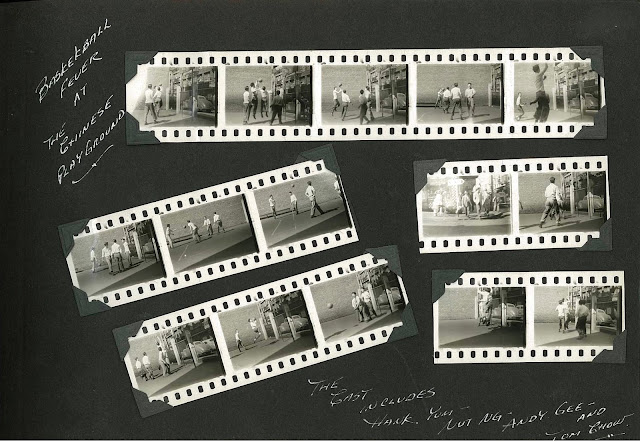
By Joy Meads As The Geary Theater prepares for the opening night of Lauren Yee’s The Great Leap , we caught up with Lauren (and her father Larry!) to learn more about the stories that inspired her. Lauren, how did you take Larry's basketball stories and turn them into a story for the stage? Lauren: Those basketball stories were a part of the family lore I never really investigated. It was only when I was thinking about what I might write for Denver Center for the Performing Arts that I really dug into these stories. And in going back to talk to my dad, I’ve discovered that I wrote some of these things in without even knowing it was in his story. Lauren Yee, award-winning playwright of The Great Leap . Larry, how did your relationship with basketball begin? Larry: When I was about seven years old, I started playing at a playground in Chinatown. Then I played pick-up basketball at the local rec center , which is now called the Betty Ong Rec Center. They used to put...

See Chinatown Through the Wong Family's Eyes

Image
By Annie Sears The Great Leap takes us from 1971 Beijing to 1989 San Francisco, where USF basketball coach Saul is whipping his players into shape to face the University of Beijing on their home court. Saul is running drills when he’s interrupted by Manford, a scrappy, 17-year-old Chinese American who wants to join the USF team on their tour to Beijing. Manford learned everything he knows on the asphalt courts in Chinatown. Playwright Lauren Yee’s father, Larry Yee, grew up playing at the Betty Ong Rec Center in San Francisco’s Chinatown, and Lauren grew up hearing the stories. “Even today,” says Lauren, “people still stop me on the street and try to explain what a legend he was. They tell me his nickname (Spider), his position (center), and his signature move (the reverse jump shot).” Larry was a part of an American team that traveled to China in the 1970s to play Chinese professional teams. The Great Leap isn’t his story, but it’s similar. William D. Wong—father of actor BD Wo...

Bay Area Roots Run Deep with The Great Leap

Image
By Miranda Ashland On a crisp February morning, staff, faculty, students, producers, and board members filed in to William Ball Rehearsal Studio for the first rehearsal of The Great Leap . Red and gold decorations hung on the walls, and in place of the established bagels and schmear, the snack table was adorned with pink boxes filled with Chinese pastries: egg tarts, pork buns, and baked egg custard buns straight from Chinatown. This was not A.C.T.’s usual meet and greet. “恭喜發財 ( Gong hei fat choy ), everybody!” said Associate Artistic Director Andy Donald, reminding us all that it was the Lunar New Year, a prominent holiday in Chinese and Chinese American culture. This first rehearsal coincidentally fell on this day, another reason why it stood apart. Playwright Lauren Yee and actor Tim Liu at the first rehearsal for The Great Leap . Photo by Miranda Ashland. Lauren Yee’s The Great Leap is a story deeply rooted in the San Francisco Bay Area. Yee grew up in Chinatown. Her ...

A Different Kind of Understanding

Image
By Annie Sears Wearing a light windbreaker and carrying a worn portmanteau, 36-year-old Iniabasi Ekpeyong shivers outside JFK International Airport. She finds a pay phone, dials an international number using a calling card, waits for someone to pick up, and says, “Uwem, mme yem itang iko mme Kufre.” Actors Aneisa Hicks (playing Adiaha) and Eunice Woods (playing Iniabasi) at the first rehearsal for Her Portmanteau . Photo by Elspeth Sweatman. Her Portmanteau , playing through March 31 at A.C.T.’s Strand Theater, employs a storytelling technique that may be unfamiliar to some audience members: the use of multiple languages onstage—without subtitles. The characters in Her Portmanteau are Nigerian, and they alternate between English and Ibibio. Audiences may not be able to understand all of the characters’ words verbatim, but that’s part of the play’s charm. It’s possible to understand the heart of the play if one leans into other modes of understanding. Communication is not on...

A Taste of Her Portmanteau

Image
By Annie Sears A culture has many defining characteristics: language, social structure, traditions, values. These elements draw people together, helping us understand our own humanity by understanding the group we belong to. One element of a culture is especially human—food. No matter who you are or where you come from, you need to eat. And when you share a meal with others, you slow down, sit together, and converse. Food quickly becomes more than food. “In Nigeria,” says Dr. Awam Amkpa, a theater professor at New York University’s Tisch School of the Arts, “food is a peacemaker at the core of inventing community—not just the communities we have, but as a way of producing community. When even total strangers come to your home, we use food as the foundation for that relationship.” In Her Portmanteau , playing at The Strand through March 31, characters share two traditional Nigerian foods onstage: afang soup and fufu. On February 24 and March 3, Eko Kitchen —a Nigerian pop-up kitch...

I Am Nigerian. I Am American. I Will Not Choose.

Image
By Elspeth Sweatman A.C.T. Master of Fine Arts Program alum Mfoniso Udofia is taking the American theater by storm. Her current project is the Ufot Family cycle, a series of nine plays exploring a family of Nigerian immigrants in America. The cycle has been workshopped at leading new-play incubators, including SPACE on Ryder Farm and Dr. Barbara Ann Teer’s National Black Theatre. Three of the plays— Sojourners , runboyrun , and Her Portmanteau —have been produced at The Playwrights Realm, Magic Theatre, and New York Theatre Workshop. Now, she is back at A.C.T. with Her Portmanteau . After 22 years apart, Nigerian-born Iniabasi Ekpeyong—bearing a worn portmanteau—reunites with her mother and half-sister in Manhattan. This coming together isn’t easy. The women must sort through their literal and figurative baggage as they uncover their personal and familial identities. We chatted with Udofia about the Nigerian American identity and the importance of having Black bodies onstage. Sce...

Welcome Home: Her Portmanteau Rehearsals Begin

Image
By Aaron Higareda The coffee is hot, the bagels are warm, and the cast and crew of Her Portmanteau are meeting and greeting inside The Rueff at A.C.T.’s Strand Theater. Every show here at A.C.T. begins with a meet and greet, where designers share their vision for the show and the cast completes an initial read before diving into rehearsals. To begin a journey, you have to leave home. But what exactly is home? Is it a location? A sensation? A memory? After you’ve left, what is it like to come back? This is a theme explored in Her Portmanteau , and it’s also a theme in the playwright’s life. Mfoniso Udofia, a graduate of A.C.T.’s M.F.A. Program (class of 2009), returns home to A.C.T. with Her Portmanteau , an independent chapter from her sweeping nine-part saga about a family of Nigerian immigrants and their American-born children. “It’s about what it means to be an immigrant in America,” said Udofia during the meet and greet. “Specifically, an immigrant who has aspirations of goin...

The Body as a Template: Seascape Movement Coach Danyon Davis on Lizards

Image
By Annie Sears For actors Seann Gallagher and Sarah Nina Hayon, getting into character involves more than putting on a costume; it involves putting on the entire physical life of a lizard. Edward Albee’s Seascape —playing through February 17 at The Geary—features two couples. One is human; the other is lizard. Portraying an animal presents unique challenges, which is where A.C.T.’s head of movement Danyon Davis offers his expertise. Davis comes to A.C.T. after serving as head of movement at Stella Adler Studio of Acting, and he’s a former faculty member at the Neighborhood Playhouse, Circle in the Square Theatre School, and HB Studio’s Hagen Core Training program. Davis also assisted Moni Yakim, founding faculty member and head of movement at the Julliard Drama Division, for many years. We recently sat down with Davis to learn about bypassing one’s human physicality to access something more reptilian. Actor Sarah Nina Hayon, wearing her rehearsal tail, listens to director Pam M...

Learning What Living Was All About

Image
By Elspeth Sweatman Born on March 12, 1928, and adopted by Reed A. and Frances C. Albee—two members of the elite in Larchmont, New York—Edward Franklin Albee III had a coddled but lonely childhood. His parents bought him everything he could have ever wanted: Grenadier Guard toy soldiers, electric trains, a smoking jacket. He went to see Broadway shows and spent the winter months in Palm Beach, Florida. But material possessions and a lavish lifestyle could not hide the fact that his parents were unloving. “Whenever his mother became angry with him, she reminded him that he was adopted,” says biographer Mel Gussow. “The inference was in the air that, if he did not behave, if he did not measure up, he could be returned to the orphanage, like an unwanted possession.” Edward Albee in 1971. Photo courtesy Cleveland State University. From an early age, Albee knew he wanted to be a writer. He began drafting poems at six, plays at 12, and novels in his teens. Albee’s dedication to his ...