Posts

Showing posts with the label DanRubin

A Brief History of The Suit
Image
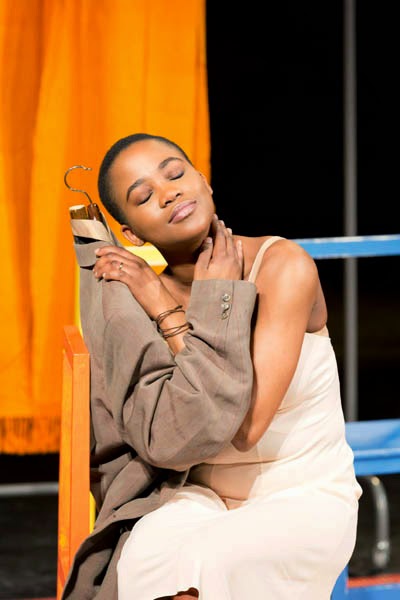
By Dan Rubin Nonhlanhla Kheswa in The Suit , Photo by Johan Persson. Can Themba’s “The Suit” was first published in the inaugural issue of a South African journal called the Classic in 1963. In 1966, while Themba was in exile in Swaziland, the South African apartheid government declared him a statutory communist and banned his work. It remained unavailable in his homeland until 1982. In 1994, Mothobi Mutloatse and Barney Simon adapted “The Suit” into a play, which premiered at Johannesburg’s Market Theatre. Director Peter Brook learned about Mutloatse and Simon’s stage adaptation of The Suit when he read about the play in a newspaper article. He requested the script, which he shared with longtime collaborator Marie-Hélène Estienne. “Ah! Yes, this is remarkable,” he remembers her saying. “But it’s only like a first draft. We could do it in our theater in Paris,” she told him, referring to the Théâtre des Bouffes du Nord, home of Brook’s International Centre for Theatre Researc...

Nonhlanhla Kheswa: The Voice of The Suit

Image
By Dan Rubin Kheswa by Nadylam The incredible South African actor/singer Nonhlanhla Kheswa has been performing the role of Matilda in The Suit since it premiered in Paris in 2012. She has traveled the world with the show, to London, Madrid, Milan, Naples, Shanghai, Beijing, and New York, just to name a few places. She has loved meeting people everywhere she has visited, but her favorite city so far has been Tbilisi, Georgia: “They suffered a war recently. . . . It reminded me so much of Alexandra, the [Johannesburg] township I grew up in, because it’s a developing country. The people’s spirits are so lively. They are just thankful that they are alive. They are thankful they’re able to breathe. And they have such an immense love for theater and art, so I felt like I was at home.” Kheswa never trained formally as an actor; in 1998, while she was still in high school, she was cast in the film Soul City . On the heels of that, she joined the cast of Disney’s The Lion King on...

The Coffee Culture of Naples

Image
By Publications Manager Dan Rubin Leading up to World War II, drinking coffee was an important ritual, considered by most to be a basic human right. The city is home to the caffè sospeso, the suspended coffee, in which a customer anonymously pays for the coffee of someone in need. Neapolitan writer Luciano de Crescenzo says, “It was a beautiful custom. When a person who had a break of good luck entered a café and ordered a cup of coffee, he didn’t pay for just one, but for two cups, allowing someone less fortunate who entered later to have a cup of coffee for free. . . . It was a cup of coffee offered to the rest of humankind.” But Italy did not grow its own coffee beans, and as the wartime blockades made importation difficult, the staple became precious—and expensive. Instead of visiting cafés, customers had to visit the black market to get their caffeine fix. Coffee came to Naples late compared to other major Italian cities. When it first arrived in the late eighteenth century, i...

The Basso Setting of Napoli!

Image
By Publications Manager Dan Rubin Napoli! takes place in a Neapolitan basso, which literally means the "lows." These windowless, street-level, studio apartments have historically been home to the city's underclass. They are cramped, and their occupants have no privacy from passersby, who can peer through the open door, the only point of both ventilation and light. In 1884, a British journalist described the dwellings as follows: Imagine a doorway of a cave where on entering you must descend. Not a ray of light penetrates into it except by the one aperture you have passed through; and there, between four black battered walls and upon a layer of filth mixed with putrid straw, two, three, and four families vegetate together. The best side of the cave, namely that through which humidity filtrates the least, is occupied by a rack and manger to which animals of various kinds are tied; a horse it may be or an ass, a calf, or a pig. On the opposite, a heap of boards and rag...

What is a Lintel?

Image
By Publications Manager Dan Rubin Playwright Glen Berger writes, "Though we rarely recognize the place, underneath the lintel is where we stand every day, every moment, of our life." In this passage, the wordsmith is exploring the idea of the lintel in relationship to the word sublime, which means a sense of awe in the presence of vastness and can be broken down into sub ("under") and limen (which is derived from "lintel"). Accordingly, we are emotionally "underneath the lintel" whenever we are overcome with a sense of the sublime. The Temple of Horus at Edfu is an example of Egyptian architecture, including the post-and-lintel doorway seen at the center of the photo. But in a more literal sense, we pass underneath lintels every day. Lintels are the top beams of most entryways, although they have become less structurally essential in modern architecture. Lintels are the limit of the threshold, which is defined not only as the space...

Ladies from Hell

Image
Posted by Dan Rubin, Publications Manager Advancing in skirmish order against the enemy Black Watch performs at the Armory Community Center through June 16. “Dan: My favorite sobriquet for the Black Watch is ‘Ladies from Hell;’ so named by the Germans in WWI, when they would come charging out of their trenches, bagpipes blaring. Assume it’s true . . . ,” A.C.T. Library Cataloger Roy Ortopan wrote me in a note after reading Words on Plays . In my research, I had not come across that name applied to the Black Watch, but, sure enough, in his autobiographical account of the Great War entitled “Ladies from Hell” R. Doublas Pinkerton (who fought with the London Scottish Regiment) writes a beautifully haunting passage about the tragic advance of the Black Watch—or “‘Ladies from Hell,’ as the Germans call the Scottishers.”—in May 1915.

Understrokes of a Modern Typer

Image
Posted by Dan Rubin, A.C.T. Publications Manager With Jordan Harrison's Maple and Vine in rehearsals, there is a lot of talk in the A.C.T. offices about nostalgia. In the play, an unsatisfied urbanite couple decides to trade in their modern-day lifestyle for a 1950s model of suburban happiness. It is a divisive proposal: is our fast-paced, electronics-driven contemporary society something we need to retreat from—and if it is, would 1955 really be where we would look to find relief? As we see below in a post by A.C.T. Publications Manager Dan Rubin, your answer might depend on when you were born. My first typewriter was my mom's. A heavy, suitcase-like apparatus that in the 1990s already felt archaic and impractical compared to our fancy dot matrix printer—which fed paper through its spindles by clawing at little, evenly spaced holes on the disposable, perforated margins that lined each page. Boomers and Gen-Xers (35- to 65-year-olds) shake their heads at this: "...

“See You Down the Road”: A Fond Farewell to Humor Abuse

Image
posted by Dan Rubin, A.C.T. Publications Manager Lorenzo Pisoni has a bit in Humor Abuse when he explains that circus folk don't say goodbye to one another after the makeup is scrubbed off, the backdrop is lowered, and the props are packed away. Instead, they say, "See you down the road." It is a fitting farewell to give Lorenzo now that the San Francisco run of his heartfelt and hilarious one-man circus story has come to a close. This was not his first time on the A.C.T. stage; it is unlikely it will be his last. Still, it is bittersweet to see this joyful show come to an end. Thankfully, the beauty of working in theater is that there is no time to wallow, especially when Wajdi Mouawad's thrilling Scorched is being brought over to the theater at this very moment! Look for more Scorched posts soon, but before Humor Abuse rides off into the sunset, it has one final gift for you. Those of you who saw the show—and we hope all of you did!—know that during every...

Your Pickle Family Circus Memories

Image
Posted by Dan Rubin, A.C.T. Publications Manager We asked you to share your favorite Pickle Family Circus memories, and you did not disappoint! Thank you to everyone who sent us moving and hilarious stories and beautiful photos. Below we're sharing some of the amazing snapshots and Pickle tales that were submitted. Add your own story to the comments section at the end of the post! Humor Abuse has been so popular with Bay Area audiences that we've added an extra Sunday evening performance on February 5, at 7 p.m., but tickets are going fast and the show must close this weekend. Like the Pickle Family Circus, soon Humor Abuse will only exist in our fondest memories, so, as Pickle cofounder Larry Pisoni used to say, "Go call everyone you know, and then call everyone you don't know," and tell them not to miss it! Laurel Bellon: "I took my daughter to the Mother's Day show at Rose Park in Berkeley for many years (these photos are from 1988). I always...

How I Learned to Juggle

Image
Posted by Dan Rubin, A.C.T. Publications Manager As Humor Abuse closes in on its final performance this weekend, A.C.T. Publications Manager Dan Rubin reflects on what he learned while researching the history of San Francisco's beloved Pickle Family Circus. Rubin interviewed several members of star Lorenzo Pisoni's multitalented family for the latest edition of Words on Plays , A.C.T.'s behind-the-scenes theater guide. Click here to order a print or electronic copy, which includes 16 of Pickle photographer Terry Lorant's dazzling photographs of the Pickle Family Circus in its heyday. Lorenzo Pisoni's parents, Pickle cofounders Larry Pisoni and Peggy Snider, juggle in the Pickle Family Circus. Photo by Terry Lorant. San Francisco's Pickle Family Circus would juggle. I am left with many things from my research into this amazing organization—an investigation that led to interviews with the two cofounders, Larry Pisoni and Peggy Snider; Peggy's daugh...

Even the Sky Is Not the Limit: The A.C.T. Master of Fine Arts Program Sky Festival, Part 3

Image
posted by Dan Rubin, Publications and Literary Associate What happens when you give talented people access to other talented people, space, and time? If you’re dealing with 38 theater folk and give them two and a half weeks, seven studios, and $25 per project, the result might look something like the Sky Festival, which recently culminated in two days filled with 13 fully (well, mostly) staged, one-hour productions. It was a magical whirlwind event (“Isn’t this like Edinburgh?” people were saying in the hallway, “Isn’t it sort of like Cannes?”), leaving us awestruck by the amazing people we have the fortune to interact with on a daily basis. We were there to support A.C.T.’s Master of Fine Arts Program students and faculty, but we were also there for ourselves to witness examples of what theater looks like when its makers are at their most raw and passionate. While the directors had to negotiate with next-to-no budget and competing demands for actors and space, they did not have to c...

Even the Sky Is Not the Limit: The A.C.T. Master of Fine Arts Program Sky Festival, Part 2

Image
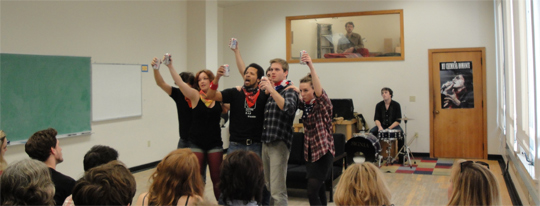
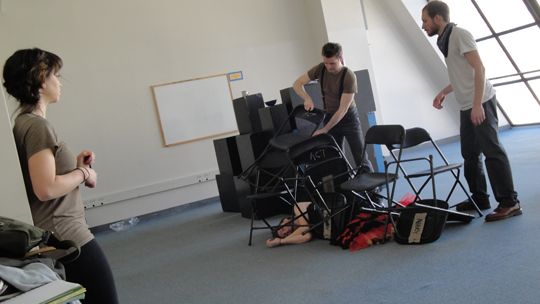
posted by Dan Rubin, Publications and Literary Associate Last week, Publications and Literary Associate Dan Rubin introduced us to three of the projects in A.C.T.’s brand-new Sky Festival. During the month of January, an eclectic array of A.C.T. M.F.A. Program students, faculty, and core company actors have been collaborating on passion projects of their choosing, putting together fully realized productions in just two weeks. Midway through the intensive rehearsal process, Dan checks in with three of these extraordinary ventures. —The A.C.T. Intern Blog Quadrumvirate Day 7 • 10 a.m. to 12:50 p.m. • Project: The Wild Goose Director: Marisa Duchowny (M.F.A. Program Class of 2011) “I like the messier shirt. The shaggier one,” Marisa tells second-year student Alex Crowther. “I want both men to be in whites and blacks—neutrals—so that she’s the splash of color.” The color comes from first-year Rebekah Brockman’s flamenco skirt, which she’s borrowing from the costume shop. She’s...

Even the Sky Is Not the Limit: The A.C.T. Master of Fine Arts Program Sky Festival, Part 1

Image
posted by Dan Rubin, Publications and Literary Associate  For most of January, all of our students and faculty are in one place, creatively speaking. This may not seem all that notable (we are a school, after all), but consider: the A.C.T. Master of Fine Arts Program is divided into three years, and each year has its own densely packed, carefully constructed curriculum. Although there is some overlap, for the most part the students in each year take different classes with different teachers, and perform in different shows in different venues. They even have different vacation schedules. And every minute of every day (okay, they’re allowed a few hours to sleep each night) is dedicated to some pedagogical activity intended to make master theater artists out of these young actors, leaving little time for personal creative expression. But this month, the entire A.C.T. faculty and student body are deeply engaged in one theatrical endeavor: the Sky Festival. The Sky Festival is a lo...

You Know What I Did Last Summer . . . ? Part 3

Image
posted by Dan Rubin, A.C.T. Publications & Literary Associate Please join me in welcoming the Master of Fine Arts Program class of 2012 . In this third of three posts about what our students did this past summer, we offer you a first glimpse into the lives of the actors who will be spending the next three years with us. Matt Bradley spent a month in Atlanta, Georgia, on his knees in The Last Days of Judas Iscariot and doing his best Adam Sandler in The Wedding Singer (the musical). He watched a lot of theater, read many books, spent a week in Sun Valley, Idaho, and, finally, moved into a little studio apartment on Pine and Hyde. Alex Crowther: “My summer was busy getting ready for the big move to San Francisco. It was a mix of good (the excitement of meeting my new classmates and learning more about what the next three years have in store), bad (the never-ending visa applications, government assistance applications, and health care coverage applications), and sad (saying...