Posts

Showing posts with the label ACTStrongWomen

Strong Women: The Women Who Influenced Janis Joplin Part One

Image
By Allie Moss During A.C.T.’s 50th-anniversary season, strong women are navigating their way through traditionally male-oriented spaces. In A Night with Janis Joplin , running through July 9 at The Geary Theater, legendary singer Janis Joplin is joined onstage by five women who inspired her iconic voice: Bessie Smith, Odetta, Nina Simone, Etta James, and Aretha Franklin. Here is a look at the first three. Bessie Smith in 1936. Photo by Carl Van Vechten.  Courtesy Library of Congress. Bessie Smith’s (1894–1937) distinctive throaty and full-bodied voice, knack for improvisation, and penchant for unexpected rhythms stand out as a clear precursor to the work of Billie Holiday, Aretha Franklin, and Janis Joplin. Joplin was so inspired by Smith that in 1970, she had a headstone made for Smith’s unmarked grave which reads “The Greatest Blues Singer in the World Will Never Stop Singing.” Odetta, 1961. Photo by Jac de Nijs.  Courtesy Wikimedia Commons.  Jan...
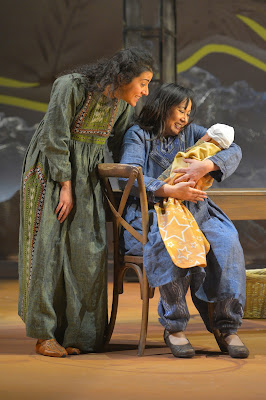
Strong Women: Mariam and Laila in A Thousand Splendid Suns

Image
By Elspeth Sweatman During A.C.T.’s 50th-anniversary season, strong women are navigating their way through traditionally male-oriented spaces. In A Thousand Splendid Suns , running through February 26 at The Geary Theater, Mariam and Laila must fight to hold onto their hopes and dreams in a world where violence and religious fundamentalism conspire to dash them. These two strong women are thrown together by the tragedy of war. Laila’s parents have been killed in a bombing, and Rasheed—Mariam’s husband—has pulled her from the rubble into their home. Although Mariam is initially suspicious of this newcomer, the two women rally together to take care of a child. Laila (Nadine Malouf) and Mariam (Kate Rigg, seated) in A.C.T.'s 2017 production of A Thousand Splendid Suns. Photo by Kevin Berne.  The women’s dreams of a better life are further threatened by the arrival of the Taliban. This Islamic fundamentalist group believed that the country’s problems were due to sinful...

Strong Women: Hilary in The Hard Problem

Image
By Elspeth Sweatman Brenda Meaney as Hilary in A.C.T.'s 2016 production  of The Hard Problem . Photo by Kevin Berne. During A.C.T.’s 50th-anniversary season, strong women are navigating their way through traditionally male-oriented spaces. In Tom Stoppard’s The Hard Problem , running through November 13, psychologist Hilary Matthews fights to find her place in a scientific world that frowns upon the “feminine” emotions of mother love, goodness, and faith. Hilary is an oddity in neuroscience: a person who believes in the power of faith as well as the power of science. This worries her university tutor Spike, who fears that this will sink her chances of an academic career. “She has what he thinks are childish notions about the self, about consciousness, and about belief,” says director Carey Perloff. But Hilary’s faith is grounded in a pivotal event in her past: when she was a teenager, she gave up her baby for adoption. To cope, she turned to her faith in the ...

Strong Women: Kate Middleton in King Charles III

Image
By Shannon Stockwell During A.C.T.'s 50th-anniversary season, strong women are navigating their way through traditionally male-oriented spaces. In King Charles III , running through October 9, Kate Middleton tries to establish her place in a kingdom run by men, both in the palace and in parliament. Because of this, critics and audiences alike have compared Kate to Shakespeare's Lady Macbeth. While playwright Mike Bartlett did not actually intend this likeness, the parallels are remarkable. Left: Ellen Terry playing Lady Macbeth. By Window & Grove. Courtesy Wikimedia Commons.  Right: Kate Middleton. By Nick Warner. Courtesy Wikimedia Commons. In Shakespeare’s Macbeth , the titular character receives a prophecy that he will become king. For him to take the throne, however, the current king must die. Lady Macbeth, whom Shakespeare scholar Marjorie Garber calls “the strongest character in the play,” knows that her husband doesn’t have the courage to kill the king, so ...

Moving The Dial: The Women's Leadership Conference

Image
By Elspeth Sweatman  “We are here today to dialogue, to create, to unearth the big questions and bold strategies for moving conversation deeper and further around women and men of color in leadership in the American theater,” said Erin Washington, A.C.T.'s Interim Artistic Producing Associate and one of the organizers of the Women’s Leadership Conference that A.C.T. hosted on Monday at The Strand. Research from the Wellesley Centers for Women.  Infographic created by A.C.T. Marketing Team. The conference began with the presentation of research conducted by Sumru Erkut and Ineke Ceder from the Wellesley Centers for Women . It was followed by responses from a panel including Seema Sueko (Deputy Artistic Director at Arena Stage), Shafer Mazow (Senior Grants Manager at Exploratorium), Michele Shay (actress, director, and producer), Elena Chang (Associate Director of Equity, Diversity & Inclusion at Theatre Communications Group), Anne Kauffman (Board Member at Stage Di...

The Women's Leadership Project Conference

By Rose Oser and Shannon Stockwell The Women’s Leadership Project began in 2013 when A.C.T. partnered with Wellesley Centers for Women (WCW), a Massachusetts-based institute devoted to gender-focused research, to do a formal study into gender disparity in regional theaters. Now, after more than three years of research, A.C.T. and WCW are excited to share the findings of that study at the Women’s Leadership Conference at The Strand Theater (1127 Market Street, San Francisco) on August 22, 2016. The morning session is free and open to the public (RSVP here to reserve your spot). The WCW researchers will share their findings, and Artistic Director Carey Perloff will lead a Q&A with a panel of arts leaders. In the afternoon, selected participants will proceed to The Rueff to discuss the research and create strategies for change. By examining a broad range of potential factors, we want to determine the specific barriers that have prevented women from rising through the ranks t...