Posts

Showing posts with the label CeciliaPadilla

The Challenges and the Joys of Directing The Last Five Years
Image
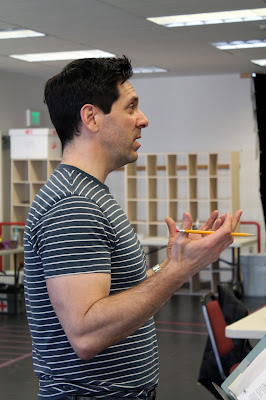
An Interview with Director Michael Berresse By Cecilia Padilla Michael Berresse came to A.C.T. in 2012 while performing in the national tour of The Normal Heart , and he is delighted to return to the Bay Area—this time as an accomplished director. “Looking back at my directorial career,” says Berresse, “I see that a number of shows I’ve worked on have had complicated or nonlinear structures. There’s something about the puzzle of them and the way my own mind works that draws me to that kind of material.” With its unique structure in which one character’s story is told from ending to beginning, and the other’s from beginning to end, The Last Five Years has been another puzzle for the director to solve. We sat down with Berresse to talk about the challenges and the joys of directing. Director Michael Berresse in rehearsal for A.C.T.’s 2016 production of The Last Five Years . Photo by Shannon Stockwell. What’s it like being both an actor and a director? I love them both for very...

A.C.T. Explores Shakespeare's Lost Play

Image
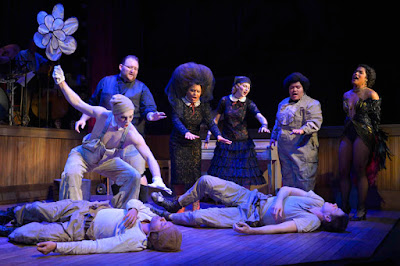
By Cecilia Padilla As a part of the 2016 Spring Performances, A.C.T.’s M.F.A. Program actors present what scholars believe is Shakespeare’s lost play. Cardenio , a romantic farce about star-crossed lovers who find each other in a play-within-a-play, has a unique creation story. Literary scholars have traced the play’s existence back to 1613, when The History of Cardenio was performed by Shakespeare’s theater company, the King’s Men. Later evidence found in 1653 indicates that the play was about to be published, and this time it was attributed specifically to William Shakespeare and John Fletcher, one of Shakespeare’s known collaborators.  Then, in 1728, Shakespeare scholar, editor, and playwright Lewis Theobald published a play called Double Falsehood . He claimed that this play was based on three different manuscripts of The History of Cardenio . Double Falsehood , Theobald said, was a mixture of Shakespeare’s, Fletcher’s, and his own writing. Theobald’s is the vers...

Storytelling in Chester Bailey

Image
An Interview with Playwright Joseph Dougherty By Cecilia Padilla  When asked what he thought his play Chester Bailey was about, playwright and television writer Joseph Dougherty responded with a quote from Harold Pinter’s Old Times : “There are things I remember which may never have happened but as I recall them so they take place.” This is the undercurrent of Chester Bailey’s vivid imaginings while recovering from a tragic shipyard accident that has left him blind and without the use of his hands. “ But he copes with it through imagination and what he chooses to remember,” says Dougherty. “I believe part of what makes us who we are is a mixture of what we remember and what we imagine.” We had the chance to speak with Dougherty about the mysteries of the play, the imagination, and the fine line between memory and reality.  How did you come up with the premise of Chester Bailey ? I saw a short article in the newspaper about someone who experienced cata...

Play of the Imagination

Image
An Interview with Shana Cooper, Director of The Unfortunates By Cecilia Padilla   “ The Unfortunates is a metaphor for facing hardship,” says director Shana Cooper. “When we fall on hard times, I am always struck by how difficult it can be to open ourselves up and be vulnerable. This show reminds us of the power in community and music. Joe’s journey exemplifies the strength it takes to let someone catch you when you fall.” After taking on the challenge of bringing Big Joe’s world to life at the Oregon Shakespeare Festival (OSF), Cooper now reimagines this hero’s journey for A.C.T.’s Strand stage. We caught up with Cooper to talk about the play’s inspiration, message, and fresh take on American music. (L-R): CJ (Christopher Livingston), Big Joe (Ian Merrigan),  and Coughlin (Jon Beavers)  face the  horrors of war in The Unfortunates .  Photo by Kevin Berne.   The Unfortunates has a unique sound and script structure. How does it compare to...

Voices Come Together: Storytelling through Music in The Unfortunates

Image
By Cecilia Padilla and Shannon Stockwell The plot of The Unfortunates is strange and engaging, its visual world outrageous and meaty. But it is the emotional score that makes the show so moving. It is the music that brings this group of misfits together and unites them in the face of tragedy. “St. James Infirmary” The initial inspiration for The Unfortunates  is “St. James Infirmary,” a classic blues song with mysterious origins. “It represents a morphing tradition,” says  The Unfortunates music director Casey Lee Hurt. “No one knows where the thing started.” It’s impossible to know the origins of the song because it comes out of an old European folk music tradition, which was based on sharing songs orally. The earliest written reference to anything resembling “St. James Infirmary” is “The Unfortunate Rake,” an Irish folk song from the seventeenth century. But the reference to St. James Infirmary dates the song even earlier than that. Although it’s unclear what h...

The American Sound: The Evolution of Jazz

Image
By Cecilia Padilla There is nothing so uniquely American as jazz music. In its simplest form, jazz embodies the essence of the American people: bold and inventive. The improvisation of the jazz ensemble can even be seen as a metaphor for the American democratic ideal: musicians playing solos have the liberty to express themselves as long as they adhere to the overall structure of the tune—individual freedom but with responsibility to the group. The evolution of jazz music also carries with it the social development of our nation from slavery to the swinging songs of World War II. Musically, jazz contributed immensely to the way contemporary musicians approach instrumentation, composition, and vocal arrangements. It is difficult to find a popular tune today that does not derive from such jazz icons as Joe Oliver, Louis Armstrong, Duke Ellington, and Thelonious Monk. Jazz is the great equalizer; for more than a hundred years, it has been the common ground between blacks and whites, me...

New Strands Festival: Thanking Our Artists and Community

Image
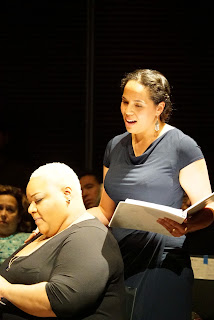
By Cecilia Padilla  Thank you to the hundreds of people who attended A.C.T.’s first New Strands Festival! Bringing together 65 artists from across the Bay Area and nationwide,  this festival  presented works-in-progress across animation, dance, music, and theater. As  The Strand comes to the end of its inaugural season, it was amazing to see our new space filled with so many different artists and extraordinary new work. Here's a glimpse of just a few festival events that took place in The Strand. Keep an eye on our website to see other exciting events like this one!    Michelle Summers (L) and Lauren Spencer (R) in a reading of How to Catch Creation  by Christina Anderson. Photo by Jay Yamada.  Thom.Green in a reading of How to Catch Creation by   Christina Anderson. Photo by Jay Yamada.  Banda Sin Nombre. Photo by Jay Yamada.  Miwa Matreyek. Myth and Infrastructure.  Photo by ...

A Lens on Small Town America: An Interview with Scenic Designer Ralph Funicello

Image
By Cecilia Padilla Despite its title, Eugene O’Neill’s Ah, Wilderness! does not take place in the wild outdoors. Instead, it depicts the home of a tight-knit Connecticut family. Bringing the world of small town America to San Francisco audiences is scenic designer Ralph Funicello, a longtime designer of A.C.T. productions. This will be Funicello’s second time working on Ah, Wilderness! with A.C.T.— he also designed the set in the 1978 production. Then, Funicello’s designs adhered to O’Neill’s textual specifications, exhibiting realistic styles and period-appropriate architecture. This time, he’s approaching the play through a new lens. “O’Neill literally dreamt up Ah, Wilderness! ,” he says, “so I want the audience to fall into the dream with him.”  Ralph Funicello's stage design in the current A.C.T. production of Ah, Wilderness! at The Geary Theater. Photo courtesy of Kevin Berne. What research has contributed to your scenic design? I still have some o...