Posts

Monstress from Page to Stage: An Interview with Playwrights Sean San José and Philip Kan Gotanda, and Author Lysley Tenorio

Image
By Michael Paller The tales that populate Monstress , by Lysley Tenorio, are as diverse as they are quirky, alternatively—and sometimes simultaneously—hilarious and heartbreaking. Artistic Director Carey Perloff read these unique short stories and knew that somehow, she had to help these vibrant short stories about Filipino American life find their way to the stage. A.C.T. reached out to some of our favorite artists and offered them the opportunity to select one of Tenorio’s stories to adapt for the stage. One of these artists was Philip Kan Gotanda, who chose to adapt Tenorio’s story, “Save the I-Hotel,” which he has renamed Remember the I-Hotel . Sean San José chose to adapt the title story from Tenorio’s collection (he renamed it Presenting . . . the Monstress! ). We sat down with Tenorio, Gotanda, and San José to talk about writing, Filipinos, and the never-ending chase for the ever-elusive American dream.   From left: Philip Kan Gotanda, Lysley Tenorio, Sean San Jo...

Eugene O'Neill's Ah, Wilderness!—The Necessary Play

Image
By Michael Paller By 1931, Eugene O’Neill, the great American tragic playwright, had won Pulitzer Prizes for Beyond the Horizon , Anna Christie , and Strange Interlude . He’d written 23 full-length plays, including Anna Christie , The Hairy Ape , Desire Under the Elms , The Emperor Jones , and All God’s Chillun Got Wings , which the police in New York attempted to close because it showed a black man kissing a white woman. That same year saw the debut and critical acclaim of Mourning Becomes Electra , his seven-hour Americanization of Aeschylus’s Oresteia set in New England during the Civil War. He was acclaimed—not without justification—as the creator of the modern American theater. Before him, American theater had been melodrama, vaudeville, and star-driven vehicles. With the aid of his collaborators at the Provincetown Playhouse, he forged an American theater that could aspire to stand beside the European accomplishments of August Strindberg, Henrik Ibs...

A Lens on Small Town America: An Interview with Scenic Designer Ralph Funicello

Image
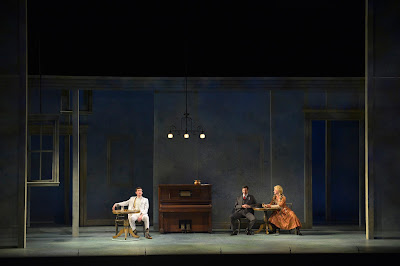
By Cecilia Padilla Despite its title, Eugene O’Neill’s Ah, Wilderness! does not take place in the wild outdoors. Instead, it depicts the home of a tight-knit Connecticut family. Bringing the world of small town America to San Francisco audiences is scenic designer Ralph Funicello, a longtime designer of A.C.T. productions. This will be Funicello’s second time working on Ah, Wilderness! with A.C.T.— he also designed the set in the 1978 production. Then, Funicello’s designs adhered to O’Neill’s textual specifications, exhibiting realistic styles and period-appropriate architecture. This time, he’s approaching the play through a new lens. “O’Neill literally dreamt up Ah, Wilderness! ,” he says, “so I want the audience to fall into the dream with him.”  Ralph Funicello's stage design in the current A.C.T. production of Ah, Wilderness! at The Geary Theater. Photo courtesy of Kevin Berne. What research has contributed to your scenic design? I still have some o...

Your College Play Will Change the Face of American Theater in These Ten Steps

Image
by Peter Friedrich 1. Three weeks before opening night, go to your college cafeteria. Eat. 2. Go back to the line and introduce yourself to any staff member. Give your first and last name, and ask for the same from them. Then ask if they like going to plays. If they say no, keep asking others until someone says yes. Let them know you have complimentary Champagne VIP seats for all cafeteria staff, friends, and family. Make sure you have 50 hard copies of tickets in your pocket at all times. They should look and feel exactly like Broadway theater tickets. 3. Go back to the cafeteria every day and build your VIP audience. Get your cast and crew to do the same—ask them at the end of each rehearsal for the names of who they talked to. VIPs at the The Tempest at Millsaps College in Jackson, Mississippi 4. On your way to the cafeteria each day before opening, be on the lookout for groundskeeping and janitorial staff. Introduce yourself. Ask their name. Pull out tickets. 5. Recr...

An Interview with Ah, Wilderness! Director Casey Stangl

Image
By Allie Moss  Director Casey Stangl. Photo by Ann Marsden. Director Casey Stangl returns to A.C.T. to stage Eugene O’Neill’s American classic Ah, Wilderness! She approaches Ah, Wilderness! with a fearlessness toward this play’s particular challenges and an appetite for unearthing truths. “I want there to be a sense of immediacy,” Stangl says. “The characters confront first love, parent-child relationships, and the difficulty of finding love and companionship as they get into their older years. These situations are so universal and are very much with us today.” We spoke to Stangl recently about her directorial vision for A.C.T.’s production of Ah, Wilderness! O’Neill is generally known for his tragic works, but Ah, Wilderness! is a comedy. How does that inform your understanding of the play?  I think that the comedy actually derives from the great depth of feeling that is in the play. These characters are real people in real situations with real consequences. But eve...

Growing Up: A Universal Journey

Image
Coming-of-Age Stories over Time  By Allie Moss Coming-of-age stories have been told practically since the start of civilization, but they did not receive a name until 1819, when German university lecturer Karl Morgenstern dubbed them the Bildungsroman . This German word translates literally as “education novel,” but its definition has expanded to encompass the entire coming-of-age genre. Teenage newsboys in New Haven, Connecticut. Photo by Lewis Wickes Hine, 1907. Courtesy Library of Congress. Although coming-of-age stories share some commonalities that transcend their publication dates, they are also intrinsically tied to what “coming of age” meant at the time they were written. Near the turn of the twentieth century (when Ah, Wilderness! is set), life for teenagers was changing, but slowly. Post–Industrial Revolution society enjoyed an increase in leisure time, so children and teenagers had more hours to spend with their friends than in the past—but they w...